<script async src="https://pagead2.googlesyndication.com/pagead/js/adsbygoogle.js?client=ca-pub-7001450216977829"
crossorigin="anonymous"></script>
The Ultimate Playbook to Outsmart the Ruthless 2026 Economy With n8n AI Automation Services
The 2026 economy is freezing, but you don't have to panic. Uncover the exact skills you need to thrive independently by providing highly-paid n8n AI automation services.
N8N AI AUTOMATION SERVICESGLOBAL EMPLOYMENT TRENDS 2026, AI JOB IMPACT, TECH LAYOFFS 2026, FUTURE OF WORK, JOB MARKET TRENDS WORLDWIDE, AI REPLACING JOBS, HIRING SLOWDOWN 2026, EMPLOYMENT CRISIS GLOBAL, WORKFORCE TRANSFORMATION, JOBS AND AI
7/2/202611 min read
Did you know that by 2030, a staggering 92 million jobs will be entirely displaced globally, while 170 million completely new roles will be created? Or that over the next two to three years, 50% to 55% of all jobs in the United States alone will be fundamentally reshaped by artificial intelligence? Welcome! I am Buzz Leaps, author and publisher of motivational books, including the recent Amazon Kindle bestseller, 'When the Money Runs Out.' My mission is to encourage people to take up independent skills that can help them break free from the traditional 9-to-5 grind and stop relying on volatile corporate jobs.
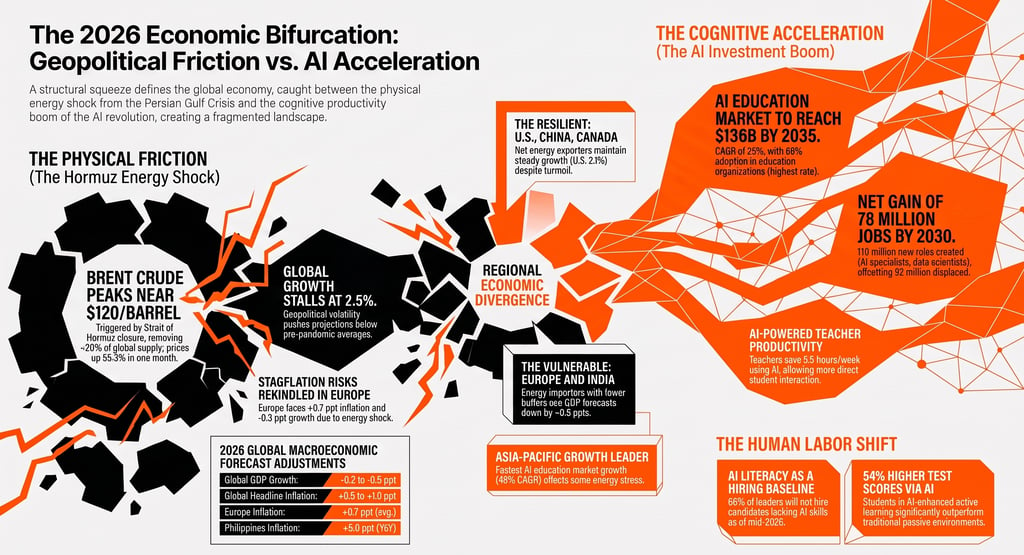
Today, we are facing an unprecedented global context: the world economy is caught in a profound tug-of-war between severe geopolitical supply-side shocks—such as the recent closure of the Strait of Hormuz—and a rapid, society-altering AI investment boom. The traditional job market is freezing up, and the rules of earning a living are being rewritten right before our eyes.
Here is everything you need to know about the state of the world in 2026, the artificial intelligence revolution, and how you can take control of your financial destiny.
Chapter 1: The Global Job Market is Stalling
If you are relying on a traditional employer for your financial security, the mid-2026 global economic landscape should serve as a massive wake-up call. We are currently navigating what economists describe as a transition toward "slack water"—a state of low churn where very few workers are being hired into new positions, and equally few are voluntarily leaving.
Let's look at the hard numbers from around the world as of May and June 2026:
United States: U.S. employers added a meager 57,000 nonfarm payroll jobs in June 2026, falling drastically short of the 100,000 to 110,000 jobs forecasted by economists. This signals a noticeable slowdown in hiring momentum. Making matters worse, job growth for April and May was revised downward by a combined 74,000 jobs. Despite this weak job growth, the unemployment rate actually ticked down slightly to 4.2% from 4.3%, but this was largely because over 720,000 people gave up looking for work and simply left the labor force altogether.
Canada: In a rare bright spot, the Canadian labor market showed unexpected resilience, surging by 87,800 net jobs in May 2026, far exceeding the anticipated 10,000 new jobs. This hiring spike drove the unemployment rate down to 6.6% from 6.9%, with job gains concentrated in full-time work across the construction, information, transportation, and food services sectors.
Europe: The unemployment rate in the Eurozone remained at a historic low of 6.2% in May 2026, while the broader European Union maintained an unemployment rate of 5.9%.
Australia: Australia's seasonally adjusted unemployment rate dropped to 4.4% in May 2026, recovering from a four-year high of 4.5% in April. The economy added 40,300 jobs, driven predominantly by a surge of 35,200 part-time positions, while full-time employment increased by only 5,000.
China: Urban youth unemployment (ages 16–24, excluding students) dropped to an 11-month low of 15.6% in May 2026, easing from 16.3% in April. The overall urban unemployment rate also edged lower to 5.1%. However, the labor market remains highly competitive, especially for the record 12.7 million college students graduating this summer.
India: India's national unemployment rate climbed to an 11-month high of 5.5% in May 2026, up from 5.2% in April. This strain is largely attributed to a rise in rural unemployment and significant macroeconomic headwinds, including a surge in energy prices linked to commercial vessel disruptions.
What does this mean for you? When the global job market stalls, traditional career ladders break. You cannot depend on a corporation to provide you with stability. As I discuss in When the Money Runs Out, true security comes from independence and highly adaptable skills.
Chapter 2: The Geopolitical Squeeze and the Energy Crisis
You cannot understand the current job market without understanding the geopolitical forces crushing the global economy. In early 2026, the military conflict between the United States, Israel, and Iran—launched under the codename Operation Epic Fury—resulted in the closure of the Strait of Hormuz.
This chokepoint crisis removed close to 20% of global oil supplies and significant liquefied natural gas volumes from the market. As a result, Brent crude oil prices surged by 55.3% to $112.57 per barrel within a single month, eventually peaking near $120. Even though a tentative ceasefire was signed in June 2026, this protracted physical disruption has driven inflation to multi-year highs, compressed real wages globally, and severely restricted economic growth.
The International Labour Organization (ILO) has warned that under a scenario where oil prices remain high, global working hours could fall by 0.5% in 2026 (equivalent to 14 million full-time jobs) and 1.1% in 2027 (equivalent to 38 million full-time jobs). Real labor income could decline by $1.1 trillion in 2026 and $3.0 trillion in 2027.
When energy prices skyrocket, corporate budgets shrink. When corporate budgets shrink, hiring freezes, and massive layoffs follow. This is the exact environment where building your own independent income streams is no longer optional—it is a survival necessity.
Chapter 3: The AI Cognitive Shift and the "Two-Track" Labor Market
While geopolitical physical constraints are compressing traditional economic growth, the deployment of artificial intelligence has emerged as the primary driver of structural changes within the global workforce. We are seeing a massive divergence between physical and digital forces.
AI is not causing immediate mass unemployment across the board; rather, it is driving a pronounced bifurcation of the labor market. PwC's 2026 Global AI Jobs Barometer reveals that AI is creating a "two-track" labor market.
Professionalised Jobs (Augmented by AI): Jobs that are "professionalised" by AI—where technology amplifies human expertise, strategy, and leadership—are thriving. The number of professionalised jobs is growing twice as fast as democratised ones, and workers in these roles are experiencing 42% higher wage growth.
Democratised Jobs (Simplified by AI): Roles that rely on routine, structured, and highly repeatable tasks are being rapidly eliminated or devalued because AI makes them easy for non-experts (or algorithms) to perform.
Over the next two to three years, 50% to 55% of all U.S. jobs will be substantially reshaped by AI. Furthermore, AI is compressing the traditional career ladder. Because AI is absorbing routine administrative tasks that used to serve as foundational early-career training, entry-level positions are now demanding traditionally senior skills, such as strategic decision-making and leadership. The most AI-exposed junior roles are 7 times more likely to demand these senior skills than the least exposed roles.
If you are a worker who embraces "AI-augmented" capabilities, the market is rewarding you handsomely. Across industries, professionals who demonstrate AI proficiency earn a 20% to 40% salary premium over their peers in equivalent non-augmented roles. For example, a traditional Software Developer might earn $110,000, while an AI-Augmented Developer earns around $145,000 (+32%). A traditional Marketing Manager might earn $95,000, while their AI-augmented counterpart earns $125,000 (+32%).
Chapter 4: Which Roles Are Dying and Which Are Booming?
To truly protect yourself, you need to know exactly which roles are in the crosshairs and which represent the future. The World Economic Forum projects that 41% of employers plan to reduce their workforce due to AI automation in the near future.
The Roles Being Eliminated or Significantly Reduced (Displacement Risk):
Data Entry and Processing Clerks: Automation feasibility is very high. Major outsourcing companies have reduced data entry headcount by 30-40% since 2024. It is estimated that 65-80% of current data entry roles will be eliminated by 2028.
Customer Service Representatives (Tier 1): Companies like Klarna have reduced customer service headcount significantly, with AI handling 70% of all customer interactions. Tier 1 roles face a 40-55% reduction by 2028.
Bookkeeping and Basic Accounting: AI tools are automating invoice processing, bank reconciliation, and expense categorization. Basic bookkeeping roles face a 35-50% reduction.
Commodity Content Writers: The market for basic SEO articles and template-based content has contracted sharply, facing a 40-60% reduction.
The Roles Being Created or Growing Massively:
AI/ML Engineers and Specialists: Demand is extreme, with Fortune 500 companies hiring aggressively. The net job impact is a massive +150% to +200% growth.
AI Ethics and Governance Specialists: Growing rapidly due to compliance requirements like the EU AI Act.
AI-Augmented Specialists (Cross-Industry): This is the largest emerging category. This includes AI-Augmented Financial Analysts (+25-40% premium), AI-Augmented Sales Reps (+30-50% premium), and AI-Augmented Marketers (+20-35% premium).
In the Financial Services sector specifically, 63% of registered independent advisors (RIAs) now utilize AI. Autonomous AI agents can process capital calls, interpret unstructured documents, and validate distributions without human intervention. As a result, paraplanners and client service associates are shifting away from manual system operations to become "service multipliers," focused on exception handling. Firms utilizing these technologies are seeing massive revenue leverage.
Chapter 5: Bridging the Gap—Why You Must Learn n8n AI automation services
As the author of When the Money Runs Out, my core philosophy is that you cannot wait for the economy or a benevolent employer to save you. When traditional jobs in customer service, basic coding, data entry, and administration disappear, what will you do?
The answer is simple: You must become the person who builds, controls, and manages the AI systems.
One of the most powerful, high-leverage skills you can learn today is providing n8n AI automation services. n8n is a powerful, fair-code workflow automation tool that allows you to connect different apps, databases, and AI models together. By mastering n8n AI automation services, you can transition from being an employee waiting to be replaced, to an independent consultant who goes into businesses and automates their operations.
Think about it: every small, medium, and enterprise-level business right now is terrified of falling behind in the AI race. They know that AI agentic workflows can increase capacity by 55% to 65% and reduce operational costs by around 40%. But most business owners have no idea how to implement these tools.
By offering n8n AI automation services, you can help companies:
Connect their CRM to advanced Large Language Models (LLMs) to automatically draft personalized client emails.
Automate their entire Tier 1 customer service ticketing system.
Build custom data extraction workflows that replace manual data entry clerks.
Set up autonomous agents that handle financial reporting and document summary generation.
You do not need to be a Silicon Valley software engineer to master this. You just need to dedicate 8 to 16 weeks to understand workflow design, API connections, and prompt engineering. Professionals who offer n8n AI automation services are completely insulated from the "slack water" job market because they are the ones driving the efficiency that companies are desperate to buy.
Stop competing for the shrinking pool of 57,000 traditional jobs. Start your own agency, offer n8n AI automation services, and write your own paycheck.
Chapter 6: The Transformation of Education and Skill-Building
If you are worried that it is too late to learn new skills, look at how rapidly the education sector itself is transforming. AI adoption in education has reached near-universal levels. During the 2024-2025 school year, 85% of teachers and 86% of K-12 students actively used generative AI tools. In higher education, a staggering 92% of students report using AI for academic purposes.
This isn't just about cheating on essays; it is about fundamentally better learning outcomes. A peer-reviewed randomized controlled trial published in Scientific Reports found that students using an AI tutor scored significantly higher than those in traditional classes, outperforming them with an effect size between 0.73 and 1.3 standard deviations. Students in AI-enhanced active learning programs achieve 54% higher test scores than those in traditional environments.
Another report highlights a 62% increase in test scores among students using AI-powered instruction systems, as these systems can identify and address knowledge gaps before they compound into larger challenges. AI bridges differences in learning styles, cultural backgrounds, and prior educational experiences, resulting in up to 70% better course completion rates.
Because of this undeniable effectiveness, the global AI in education market, valued at $7.05 billion in 2025, is projected to explode to $136.79 billion by 2035.
For you, this means that the barrier to learning complex, high-income skills like n8n AI automation services has never been lower. You have access to AI tutors that can guide you step-by-step, explain complex API integrations, debug your code, and accelerate your learning curve exponentially. The tools to free yourself are literally at your fingertips.
Chapter 7: The Fragmented Global AI Governance Maze
As you step into the world of AI, you must be aware of the complex legal frameworks being established worldwide. The pervasive integration of AI has triggered a highly fragmented global regulatory response.
The European Union: The landmark EU AI Act is now actively enforceable. It places strict obligations on "high-risk" AI systems, particularly those used in HR and employment. Using AI to infer emotions (like facial expression or voice stress analysis) in the workplace or educational institutions is strictly prohibited as of February 2025. Furthermore, AI used for HR functions—such as automated screening and candidate shortlisting—requires mandatory bias testing, human oversight, and transparency disclosures by August 2026.
The United States: Without a comprehensive federal AI law, individual states are creating a complex patchwork of regulations to fill the void.
Colorado recently repealed its landmark AI Act, replacing it with a scaled-back, business-friendly framework taking effect in 2027.
Connecticut enacted the AEDT Act (SB 435), mandating transparency, anti-bias protections, and strict disclosure requirements in AI employment decisions starting in October 2027.
Illinois has also proposed stringent state laws regarding AI in employment.
Canada: In June 2026, Canada released its refreshed national AI strategy, focusing on scaling domestic AI firms and implementing public safeguards, moving away from its initial, defunct AIDA framework.
India: India introduced its AI Governance Guidelines in early 2026, anchored in scaling infrastructure and mitigating societal risks, while enacting mandatory 3-hour takedown windows for illegal synthetic content (SGI) and mandatory AI labeling.
The Hidden Human Cost
As we celebrate the efficiency of AI, we must acknowledge the invisible human cost of these supply chains. Beneath the sophisticated algorithms powering global AI models is a vast workforce of data annotators and content moderators located primarily in the Global South, including India.
By 2021, an estimated 70,000 workers in India were employed in data annotation, reviewing thousands of pieces of violent, abusive, and sexually explicit media daily to train AI safety filters. Because these workers are classified as independent contractors or gig workers, local labor laws fail to protect them. They are systematically excluded from formal employee protections under the newly consolidated Indian Labor Codes, leaving them unprotected from severe psychological hazards and occupational traumas. This grim reality is yet another reason why you must strive to build skills at the top of the value chain, rather than settling for precarious gig work at the bottom.
Taking Back Control: Why You Must Become Independent
We are living in an era where waiting for a paycheck is a tremendous risk. The inflation driven by conflicts like the Strait of Hormuz crisis is eating away at your purchasing power. At the exact same time, artificial intelligence is reshaping 55% of all jobs, turning traditional career paths into dead ends.
As I have detailed extensively in 'When the Money Runs Out,' the only true security in this world is your ability to generate value independently. You cannot rely on a system that is actively automating your tasks. You must pivot.
By learning and offering n8n AI automation services, you transition from being a victim of the AI revolution to one of its primary architects. You become the indispensable expert who helps struggling businesses navigate this transition. You command the 30% to 40% salary premiums. You dictate your hours, your clients, and your future.
The jobs report may be a flatline, and the geopolitical landscape may be chaotic, but the opportunity for individual creators, consultants, and highly-skilled technical entrepreneurs has never been greater.
Stop waiting. Start learning. Become independent.
References & Authenticity Links:
PwC: 2026 Global AI Jobs Barometer
BCG: AI Will Reshape More Jobs Than It Replaces
Trading Economics / Fibre2Fashion: Australia Unemployment Rate May 2026
Canadian Affairs / Statistics Canada: Canada sees surprise jobs hike, unemployment rate drops
Trading Economics / Asia Today: China Youth Jobless Rate Falls to 11-Month Low
CBS News / The Guardian: Employers added 57,000 jobs in June, far below forecasts
Eurostat / Demócrata: Euro area unemployment at 6.2%
Moody's / Wealth Management: From pilots to agents: How the second wave of AI is transforming asset management
Global Employment Trends and the Artificial Intelligence Transition: A Mid-2026 Structural Assessment
LiveLaw: How India's Labour Laws Fail To Protect Workers Behind AI Content Moderation
Trading Economics / DD India: India Unemployment Rate
Teamed Global / EU Artificial Intelligence Act: What the EU AI Act Means for Staffing Businesses
ReedSmith / Proskauer: State AI hiring tool regulations filling federal void; Connecticut Enacts New AI Law
AI Magicx: The 2026 AI Job Disruption Report
Engageli / Faculty Focus: 25 AI in Education Statistics to Guide Your Learning Strategy in 2026; Designing the 2026 Classroom
Innovative AI Solutions / Press Information Bureau: India AI Governance Guidelines
Crewdle / Connect On Tech: Canada Federal Government Releases Refreshed National AI Strategy
International Labour Organization (ILO): Employment and Social Trends: May 2026 Update
SmartAsset: Will AI Replace Financial Advisors?