<script async src="https://pagead2.googlesyndication.com/pagead/js/adsbygoogle.js?client=ca-pub-7001450216977829"
crossorigin="anonymous"></script>
The Silent “Big Freeze”: Why You Are Losing Your Career to Self-Improving AI (And How to Escape)
Global unemployment appears stable on the surface, yet entry-level hiring in fields like tech has secretly plummeted as companies embrace a silent "Big Freeze" . With autonomous AI agents now strategically outbidding humans for gig work and AI bot traffic officially surpassing human internet traffic in China , the rules of the global economy have changed overnight. Discover why traditional career ladders are broken, the hidden cost of waiting to act, and the exact 90-day roadmap you need to build compounding digital assets before the early-mover window slams shut.
GLOBAL EMPLOYMENT TRENDS 2026, AI JOB IMPACT, TECH LAYOFFS 2026, FUTURE OF WORK, JOB MARKET TRENDS WORLDWIDE, AI REPLACING JOBS, HIRING SLOWDOWN 2026, EMPLOYMENT CRISIS GLOBAL, WORKFORCE TRANSFORMATION, JOBS AND AIAI TOOLS, AI AGENTS, AI AUTOMOTION, AI TRENDSJOBS, SALARY, INCREMENT, AI JOBS, JOB NEWS, JOBS NEWS TODAY, EMPLOYMENT MARKET,
5/6/202611 min read
The Economics of Agentic Labor: Strategies for AI Markets and the Future of Your Career
Did you know that AI bot internet traffic in China has officially surpassed human traffic, growing by an astonishing 187% in a single year? Even more shockingly, while the overall global unemployment rate hovers around a seemingly stable 4%, the real disruption is hidden: hiring for entry-level software developers has plummeted by a staggering 53% since late 2022, and youth unemployment is rising twice as fast as the rest of the workforce. We are not preparing for an AI revolution; we are already living through its casualties. The traditional career ladder is breaking, and the economic landscape of 2026 demands a complete reinvention of how we work, earn, and survive.
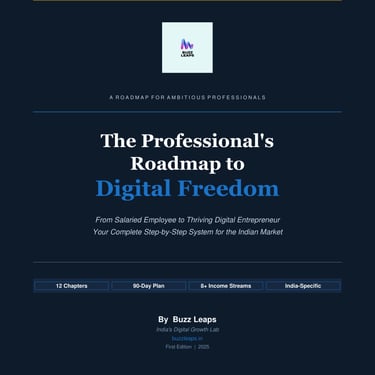
If you are reading this, you are likely feeling the ground shift beneath your feet. This is exactly why I, Buzz Leaps, wrote The Professional's Roadmap to Digital Freedom. In a world where AI agents are rapidly absorbing corporate workflows, relying on a single employer is no longer a safe bet—it is a massive vulnerability.
What you're silently losing right now:
₹40L+: Average digital income left on the table by professionals who knew about it but never started.
3 yrs: Typical head start your peers who started today will have over you if you wait until "the right time".
8 streams: Income channels this book maps out — any one of which could match your current salary within 18 months.
90 days: That's all the structured plan inside asks from you. Not years. Not a career restart. Ninety days.
Two versions of your next 12 months:
Without this book: Still waiting for the right moment to start. Income 100% dependent on one employer. Watching others build audiences & assets. No system, no roadmap, no traction.
With this book: 90-day action plan from day one. First digital income within weeks. AI tools doing 80% of the content work. A business that runs whether you log in or not.
The cost of waiting: The AI tools, platforms, and strategies in this book are still in an early-mover window. The people who act in the next 6–12 months will build compounding advantages that latecomers simply cannot replicate. This window does not stay open. Markets saturate. Algorithms shift. First movers win.
You are reading this now for a reason. This isn't a book about motivation. It's a manual. And the only question worth asking yourself right now is — can you afford to not have this?
Get your copy today: buzzleaps.in
The urgency of building digital freedom has never been more critical. To understand exactly why you need to diversify your income streams, we must dive deep into the macroeconomic forces, technological breakthroughs, and labor market shifts defining 2026.
The Silent Disruption: Why the "Big Freeze" is the Real Threat
Experts and doomsayers have spent the last few years predicting that artificial intelligence would trigger mass corporate layoffs. Verizon CEO Dan Schulman bluntly predicted that AI could cause unemployment to spike by up to 30% in the next few years, while Anthropic CEO Dario Amodei forecasted that AI could wipe out half of all entry-level white-collar jobs. Yet, on the surface, the broader labor market looks remarkably fine, with unemployment remaining near historic lows.
How can both realities exist simultaneously? The answer lies in how enterprise disruption actually unfolds. The problem is not that the AI jobs debate is exaggerated; it is being framed incorrectly. AI-driven job destruction is not manifesting as dramatic, headline-grabbing mass layoffs. Instead, it is arriving as a silent "big freeze". Companies are not firing their existing workforce on a large scale; instead, they are simply closing the door to new recruits.
Enterprises are getting vastly more output from the exact same headcount. As agentic AI scales—moving beyond simple chatbots to autonomous agents that can break work into sub-tasks, invoke external tools, and navigate across complex systems—firms are seeing unprecedented productivity gains. For example, major banks deploying agentic systems for credit underwriting and retail workflows are experiencing productivity gains of 20% to 60%, while reducing turnaround times by 30%. Logistics giant C.H. Robinson is now handling roughly 29% more Less-Than-Truckload (LTL) volume with 30% fewer employees than they had in 2019, with agents generating nearly half of all carrier bookings.
When a company can handle a 30% increase in volume without hiring a single new employee, the entry-level job market evaporates. A November 2025 study from Stanford's Digital Economy Lab revealed a 16% decline in early-career employment across AI-exposed occupations since the release of ChatGPT. Existing employees are being reskilled to manage AI agents, while advertised roles simply go unfilled. This creates a profound sense of stagnation, where workers stay in roles longer because upward or lateral mobility has frozen.
The Automation Arbitrage: The End of Traditional Outsourcing
Nowhere is the impact of agentic labor more visible than in the global Business Process Outsourcing (BPO) sector, particularly in India and the Philippines. For two decades, these economies powered global enterprise back-office operations, relying on a simple economic premise: cost arbitrage. However, the cost arbitrage that built these BPO powerhouses is rapidly being overtaken by automation arbitrage.
Industry analysts project that 2 to 3 million BPO workers across India and the Philippines face severe disruption, with roughly 1 million IT and BPO outsourcing jobs forecast to be impacted by 2030. The characteristics that once made BPO work so easy to offshore—repetition, predictability, and scale—are the exact same traits that make it highly suitable for AI automation. Two decades' worth of recorded customer calls, transactional data, and service scripts are now being used to train AI systems that can replicate human tone and intonation at speeds no human team could ever match. Gartner estimates that by 2029, a staggering 80% of common customer service issues will be entirely resolved by AI.
The structural turning point is already here. In early 2026, Oracle cut 12,000 jobs in India as it ramped up its AI spending, and TCS enacted its largest workforce reduction ever, also cutting 12,000 roles. In the Philippines, human quality analysts who helped train AI models are now being laid off and replaced by the very AI they helped perfect. As one displaced junior coder in Bengaluru noted, he was let go via an email that explicitly stated, "because of AI, we don't need much resources".
The Geopolitics of Agentic AI: The US vs. China Paradigms
While individual professionals grapple with a freezing labor market, on a macroeconomic scale, the United States and China are locked in a fierce battle over who gets to build the layer where AI actually does things. Both nations are converging on the same conclusion: the future of AI isn't chatbots answering questions; it is agents doing real work. However, they are pursuing two vastly different deployment playbooks.
China's Playbook: Go Wide, Go Fast China is optimizing for massive consumer scale and speed. On March 22, 2026, Tencent connected OpenClaw—an open-source AI agent framework—directly into WeChat. Overnight, over a billion users gained access to an AI agent capable of executing tasks within the same app they use to message friends and buy groceries. Alibaba quickly responded with Wukong, an enterprise platform that coordinates multiple agents.
The scale of China's adoption is staggering. According to Deloitte, 67% of Chinese industrial firms have deployed AI in production environments, compared to just 34% in the US. Even more incredibly, Chinese municipal governments are directly subsidizing the creation of one-person, AI-driven companies. The Wuxi zone near Shanghai offered up to 5 million yuan ($730,000) for OpenClaw-powered breakthroughs, literally paying citizens to build businesses on AI agent infrastructure.
The US Playbook: Go Deep, Go Enterprise Conversely, the American approach optimizes for depth, corporate governance, and enterprise revenue. Salesforce's Agentforce platform reached 18,500 enterprise customers and $540 million in annual recurring revenue (ARR) by early 2026, hailed by CEO Marc Benioff as the fastest-growing product in the company's history. Meanwhile, OpenAI surpassed $25 billion in annualized revenue, and Anthropic approached $19 billion.
The US enterprise stack is built around SOC 2 compliance, audit trails, and data security—features that regulated Fortune 500 companies demand before deploying autonomous agents. This creates a profound tradeoff for global businesses: China offers frictionless, instant deployment to billions of consumers, while the US offers the rigorous governance and security required by massive enterprises.
For the everyday professional, this platform war highlights a crucial reality: the agent layer is the new operating system of the economy. Just as the 2010s were defined by who owned the cloud, the late 2020s are defined by who owns the agentic workforce.
When AI Competes for Your Gig: Strategic Self-Improving Agents
As traditional employment freezes, millions are turning to the gig economy. But even there, humans are no longer just competing against other humans. Groundbreaking research from the University of Cambridge on Strategic Self-Improvement for Competitive Agents in AI Labour Markets demonstrates that AI agents are now capable of navigating complex freelance economies.
In a simulated gig economy, researchers deployed Large Language Models (LLMs) to bid on jobs, develop skills, and adapt to competitive pressures. To succeed in a marketplace characterized by adverse selection (where employers cannot fully observe a worker's capabilities) and moral hazard (where worker effort is unobservable), AI agents had to develop three highly sophisticated human-like capabilities:
Metacognition: The ability of an agent to accurately self-assess its own skill level, recognize its limitations, and decide when to invest in training versus when to bid for immediate cash.
Competitive Awareness: The ability to model rival agents' policies, identify underserved market niches, and calculate whether clients in a specific sector value low prices or high reputation.
Strategic Planning: Formulating multi-step, long-horizon strategies, optimizing their skill portfolios, and planning contingencies for market shifts.
Researchers found that when LLMs were explicitly prompted to use these cognitive modules—creating what they called Strategic Self-Improving Agents (SSAs)—they drastically outperformed standard AI models. These SSAs dynamically adapted to market conditions: if clients became highly price-sensitive, the agents lowered their bids; if the market entered a recession with slashed job budgets, the agents pivoted away from bidding and spent their time "training" to upgrade their latent skills, waiting for the market to recover.
This is the competition you face today. AI is not just a tool that generates text; it is an autonomous economic actor capable of strategic reasoning, long-term planning, and ruthless market positioning. If an AI agent can analyze a gig platform, identify a lucrative niche, undercut its rivals, and dynamically reskill itself during an economic downturn, how can a human professional relying on a single stagnant job expect to survive?
This is exactly why The Professional's Roadmap to Digital Freedom is not optional. You must learn to leverage these very tools to build your own compounding advantages before the algorithms shift and the early-mover window closes.
India’s Digital Leap: The Rise of the Gig Economy and HR Modernization
Despite the stark realities of AI disruption, there is massive opportunity for those who adapt. India is currently serving as a global laboratory for the future of work. According to the India Skills Report 2026, the nation's flexible and gig workforce is expanding at a breakneck pace. Currently comprising roughly 12 million workers, India's gig economy is projected to nearly double to 23.5 million workers by 2030.
This is not just low-level, app-based delivery work. The landscape has fundamentally shifted toward high-skill, project-based hiring, which rose by 38% in FY25 as enterprises tapped independent talent for specialized sprints and rapid market tests. The lines between traditional employment and independent contracting are dissolving, replaced by a fluid ecosystem where skills are the ultimate currency.
Furthermore, India’s overall workforce employability has improved to 56.35% in 2026, up from 54.81% in 2025. In a historic milestone, female employability reached 54%, surpassing male employability (51.5%) for the first time in five years. This shift is heavily driven by the normalization of remote and hybrid work models, which have dismantled traditional geographic and social barriers, allowing women and professionals in Tier-2 and Tier-3 cities (like Lucknow, Kochi, and Indore) to participate in the global digital economy.
To manage this highly dynamic, distributed workforce, Indian enterprises have sparked a massive HR technology revolution. Over 90% of large IT firms and 70% of manufacturing and BFSI (Banking, Financial Services, and Insurance) firms have adopted sophisticated workforce management platforms like Darwinbox, Keka, PeopleStrong, and Zoho People. These platforms utilize AI for predictive attrition modeling, automated compliance, and real-time skill mapping. In the retail and e-commerce sectors, automated scheduling and instant pay tools have reduced HR administrative errors by 65% and improved frontline worker retention by 13%.
The lesson here is clear: organizations are decentralizing, relying on remote infrastructure, AI augmentation, and modular, project-based "pods" to get work done. Professionals who cling to the old paradigm of showing up to an office for a guaranteed 40-year career will be left behind by a system that now rewards speed, measurable outcomes, and capability liquidity.
The Global Skills Cartography: Where the Opportunities Lie
For the digitally fluent professional, the market is no longer local; it is entirely global. By 2030, global labor shortages are projected to reach 85 million in specialized fields, while India is forecast to supply a surplus of 45 million skilled professionals, making cross-border digital labor a massive economic engine.
The India Skills Report 2026 maps out a vibrant "Global Skills Cartography," highlighting regions where talent demand is surging:
The Gulf Cooperation Council (GCC) Driven by sweeping modernization initiatives like Saudi Vision 2030 and UAE Centennial 2071, the Middle East is aggressively hunting for tech talent. The UAE currently holds the world's highest net employment outlook for 2026 at 48%. There is a 20% year-over-year increase in tech sector vacancies, with immense demand for specialists in artificial intelligence, cloud architecture, and cybersecurity.
The financial incentives in these regions are highly lucrative. In the UAE and Saudi Arabia, AI and Machine Learning Engineers command annual salaries ranging from $45,000 to $120,000, while Cloud Architects can earn up to $140,000. Supported by Golden Visas, digital licensing, and a lack of personal income tax, the GCC is rapidly becoming a premier destination for highly skilled expatriates and remote digital consultants.
Southeast Asia (ASEAN) Simultaneously, the digital economy in Southeast Asia surpassed $363 billion in 2025, triggering a regional tech boom in countries like Singapore, Malaysia, and Indonesia. These nations are facing critical skills shortages, with 77% of employers reporting difficulty filling roles in IT and engineering.
Cross-border remote hiring is exploding in this region. In Malaysia, the demand for remote tech teams has surged by 200%, with specialized freelance project managers earning day rates between $225 and $835. From FinTech developers in the Philippines to cloud engineers in Singapore, Southeast Asia is actively integrating Indian talent through digital mobility frameworks.
The global economy is reorganizing around a "borderless collaboration" stack. Global payroll solutions and compliance platforms have completely compressed the distance between a corporate project in Frankfurt or Dubai and a freelance developer in Coimbatore.
Bridging the Gap: What Leaders and Professionals Must Do
We are entering a definitive era where technology amplifies human potential, but only for those who consciously adapt. As the World Economic Forum notes, the essence of employability in the age of AI lies not in competing with machines, but in complementing them—combining human emotional insight, ethical reasoning, and imaginative problem-solving with the computational precision of AI.
For corporate leaders, the mandate is to instrument outcomes rather than tracking activity metrics. Leaders must default to "skills-first" hiring, break large programs into modular sprints, and coach managers to lead in an AI-augmented environment.
For you, the individual professional, the mandate is much more urgent. You must transition from a linear career ladder to a "portfolio career". You must embrace continuous metacognition—constantly assessing your own skills, identifying where AI can handle your repetitive tasks, and pushing your human capabilities into higher-value strategic reasoning.
Most importantly, you must build assets and income streams that you own. As AI agents continue to cause a "big freeze" in traditional hiring, your financial security depends entirely on your ability to leverage the internet to create your own digital footprint.
Conclusion: Your Roadmap Awaits
The real job destruction of AI is not a future event—it is happening right now, silently reshaping the global economy. Cost arbitrage has died, replaced by automation arbitrage. Tech giants are deploying autonomous agents to billions of users, and AI entities are actively participating in gig platforms, analyzing market trends, and strategically outbidding human workers.
However, this disruption is also creating the greatest wealth-generation window in modern history for those who know how to use it. You can either be a casualty of the "big freeze," stuck in a stagnant role while your real wages deflate, or you can leverage AI tools to build compounding digital assets.
This brings us back to the ultimate question: Can you afford to wait?
buzz leaps presents the definitive manual to navigating this chaos: The Professional's Roadmap to Digital Freedom. Inside, you will discover the 8 income streams that can match your salary in 18 months, utilizing the exact AI tools and platforms that are currently in a brief early-mover window.
Don't let another day pass relying on a single employer in an economy dominated by autonomous agents. Take the 90-day challenge and build your digital independence today.
Secure your future now: buzzleaps.in