<script async src="https://pagead2.googlesyndication.com/pagead/js/adsbygoogle.js?client=ca-pub-7001450216977829"
crossorigin="anonymous"></script>
The Job Market Collapse: Essential AI Automation Tools for Solopreneurs
Is your career safe from the 2026 AI revolution? Uncover the devastating truth about entry-level tech jobs and learn how leveraging AI automation tools for solopreneurs can help you build an independent, layoff-proof business.
AI AUTOMATION TOOLS FOR SOLOPRENEURS,GLOBAL EMPLOYMENT TRENDS 2026, AI JOB IMPACT, TECH LAYOFFS 2026, FUTURE OF WORK, JOB MARKET TRENDS WORLDWIDE, AI REPLACING JOBS, HIRING SLOWDOWN 2026, EMPLOYMENT CRISIS GLOBAL, WORKFORCE TRANSFORMATION, JOBS AND AIAI TOOLS, AI AGENTS, AI AUTOMOTION, AI TRENDS
5/26/202614 min read
In the first few months of 2026 alone, over 110,000 highly skilled professionals woke up to find their careers vaporized—not by a failing economy, but to fund a silent, invisible replacement. Yet, there is a far more horrifying statistic that almost no one is talking about—a devastating 20% freefall in just two years that threatens to quietly dismantle the future of our youth and the very foundation of the traditional "safe" career path. I’ll reveal the exact nature of this chilling plunge at the end of this post, and trust me, it changes everything you thought you knew about job security.
I am Buzz Leaps, author and publisher of motivational books. My life’s mission is to encourage you to take up skills that make you independent. Relying on a traditional job is no longer safe. Your livelihood can be wiped out overnight by AI, global conflicts, government decisions, arbitrary company policies, and the unpredictable current situations we are all experiencing. The era of the corporate safety net is dead. Welcome to the era of the independent creator, where your survival depends entirely on your ability to adapt, upskill, and leverage the very technologies that are displacing the masses.
This comprehensive guide will break down exactly how AI and automation are reshaping the global job market across the USA, Canada, Europe, Australia, China, and India. By understanding the macroeconomic shifts and the deployment of AI agents, you will see exactly why you must stop relying on employers and start building your own independent future.
Part 1: The Great Global Capital Realignment
We are currently witnessing a massive structural reallocation of capital in the global technology sector. The workforce reductions we are seeing in 2026 are not unfolding as a cyclical retreat; they are a deliberate strategy to free up corporate cash flow to fund unprecedented expenditures on artificial intelligence infrastructure.
To put this into perspective, major technology firms are expected to collectively spend over $700 billion on AI infrastructure, advanced chips, and data centers in 2026. Where is that money coming from? It is coming from the payroll of human workers.
Intuit is eliminating approximately 3,000 jobs—representing 17% of its global workforce—to streamline operations and integrate AI services.
Meta Platforms executed around 8,000 job cuts globally as part of an AI-led operational restructuring, effectively redirecting resources to fund its massive $100 billion annual AI capital expenditure.
Oracle initiated roughly 30,000 layoffs globally to optimize engineering functions and dynamically reallocate funds toward centralized infrastructure.
This restructuring has created a sharp divergence between corporate valuation and labor stability. Companies are discovering that they can appease shareholders by cutting human costs and simultaneously branding themselves as "AI-first." Some analysts refer to this as "AI washing"—using AI as a convenient scapegoat to get away with massive layoffs that boost stock prices and increase CEO wealth. Regardless of the corporate motive, the outcome for the everyday worker remains the same: your job is not secure.
Part 2: Regional Realities – A Worldwide Workforce Disruption
The implementation of artificial intelligence has created highly divergent labor market pressures, policy responses, and workforce sentiments across different global economies. Let's look at the breaking news and headlines defining the job market worldwide.
The United States: Entry-Level Anxiety and the H-1B Crisis
In the United States, technology enterprises are aggressively executing capital reallocation strategies, using the proceeds of white-collar layoffs to fund expensive computational infrastructure. This shift has put immense pressure on early-career hiring. While overall job openings hit a 12-month peak at 15% above the baseline in early 2026, hiring velocity has flatlined. Entry-level openings rose by 18%, but actual entry-level hiring rose only 3%.
The structural changes driven by AI have eroded early-career confidence. Today, only 19% of entry-level job seekers report feeling "very confident" about their careers, while 44% cite job security as their primary consideration when evaluating roles.
For foreign nationals, the situation is even more dire. Indian professionals represent the single largest group of H-1B visa holders in the U.S., accounting for 283,772 of the 406,348 approved petitions in FY25. The major layoffs at Meta, Amazon, and LinkedIn have left thousands of these professionals facing a strict 60-day window to secure a new sponsoring employer in a highly cautious hiring market, or face forced departure from the country. The dream of corporate loyalty has become a nightmare of visa countdowns.
India: The Collapse of Offshore Labor Arbitrage
India’s technology sector is experiencing a severe structural crisis driven by the automation of entry-level software tasks. For decades, the Indian IT model was built on labor arbitrage—Western companies outsourced work to India because skilled engineers cost a fraction of their US or European counterparts.
AI has completely flipped that equation. When a large language model or an autonomous agent can handle basic code reviews, customer support scripts, and data processing, the economic advantage of hiring thousands of offshore junior developers disappears.
The numbers tell a stark story:
Multinational Global Capability Centres (GCCs) in India have slashed their recruitment plans by 30% to 50%.
Large GCCs that previously hired over 5,000 graduates annually are scaling their targets down to approximately 2,000.
Tata Consultancy Services (TCS), India's largest IT employer, cut its entry-level graduate intake to 25,000, down from its historical average of 40,000 per year—a 37.5% reduction.
India graduates over one million engineers annually, but the traditional career path of placing them into IT outsourcing firms is narrowing rapidly. While demand for highly specialized machine learning and cloud engineering roles has increased, these positions number in the thousands, failing to absorb the vast supply of entry-level graduates. The old system is breaking down.
Canada: Sectoral Polarization and Shifting Career Plans
The Canadian labor market is experiencing concentrated, highly polarized AI adoption. Statistics Canada data highlights a steep sectoral divide: while overall business adoption of AI rose from 3% in 2022 to 12% in 2025, usage is concentrated in finance and insurance (exceeding 30%), compared to just 1.5% in accommodation and food services.
This polarization is deeply impacting workforce planning and career paths. A staggering 57% of Canadians aged 18 to 24 report that AI is actively affecting their long-term career choices. With youth unemployment at 13.8%, 49% of young Canadians are being forced to reconsider their career paths or change industries entirely.
However, Canada is also seeing a massive reskilling trend. 26% of university-educated workers in Canada are actively building new skills to utilize AI. They are realizing what I always teach: you must adapt to survive.
Europe: Algorithmic Management and Total Factor Productivity
In Europe, the primary immediate impact of AI is the rapid spread of algorithmic management tools, which are now utilized by 79% of European firms. These systems influence work pace, autonomy, skill use, and performance monitoring. While algorithmic management can reduce worker exposure to repetitive physical labor, it frequently increases work intensity, tightens deadlines, and subjects workers to continuous surveillance.
The macroeconomic effects of AI adoption in Europe are becoming highly measurable. Employed individuals in the EU estimate that they save an average of 7.4 hours of work per month due to AI, representing a 4.6% perceived efficiency gain. Furthermore, an EIB study matching data across 12,000 non-financial firms in the EU and US found that AI adoption increases labor productivity by 4%.
Europe is also navigating strict new regulations. The EU AI Act's high-risk AI obligations and incident reporting requirements take effect on August 2, 2026. This regulatory environment is forcing companies to be extremely careful about how they deploy AI, leading to a focus on transparency and ethical deployment.
Australia: Augmentation Narratives vs. Corporate Restructuring
The Australian labor market remains tight, with unemployment sitting near historic lows at 4.1% as of May 2026. The Australian government and industry groups frame AI as a mechanism for job augmentation rather than mass replacement. The Jobs and Skills Australia Generative AI Capacity Study estimates that only 4% of Australian roles are highly exposed to automation, while 21% face medium-to-high exposure, primarily in clerical, administrative, and data entry roles.
In contrast, trades, construction, healthcare, and hospitality are projected to grow and remain highly insulated. Australia is experiencing one of the worst skilled trades shortages in its history, and AI is acting as a lifeline by automating quoting, smart scheduling, and invoice management—saving tradies 5 to 10 hours per week on paperwork.
However, worker sentiment remains highly hesitant. Nearly one in three Australians fears their job will eventually disappear due to AI. This anxiety is fueled by localized corporate restructurings, such as Atlassian cutting 500 local jobs and WiseTech letting 2,000 employees go. While tech CEOs often claim AI is just changing the "mix of skills" required, experts suspect that AI is frequently used as cover for other financial pressures and organizational restructuring.
Rejecting the mass-layoff trend, the Commonwealth Bank of Australia (CBA) is investing $2.4 billion annually in technology and has launched a $90 million Future Workforce Program focused on large-scale reskilling and internal mobility to transition workers with dignity.
China: Public Optimism and the Scale of Humanoid Robotics
China’s competitive edge in the global AI landscape is increasingly driven by unusually strong public and workforce optimism. A University College London (UCL) survey reveals that less than 10% of Chinese respondents are worried that AI will damage their job prospects, while 96% report using AI at work on a weekly basis.
Because the Chinese workforce views AI as a supportive tool rather than a replacement threat, employees are highly receptive to job redesign. This allows Chinese firms to transition rapidly from software pilots to real-world deployments.
Chinese policymakers are utilizing AI as a core tool to boost productivity and offset the economic challenges of an aging population. China is the global leader in robotics, accounting for 85% of global humanoid installations in 2025. Analysts project that China will deploy up to 24 million humanoid robots into its workforce by 2035—equivalent to roughly 4% of China's total labor force—to directly address a projected 37 million worker shortfall in its manufacturing base.
Part 3: The Myth of the "Safe" Job vs. The Jevons Paradox
If you are waiting for a corporation or a government to save you, you are playing a losing game. To understand why, we must look at the cognitive footprint of automation.
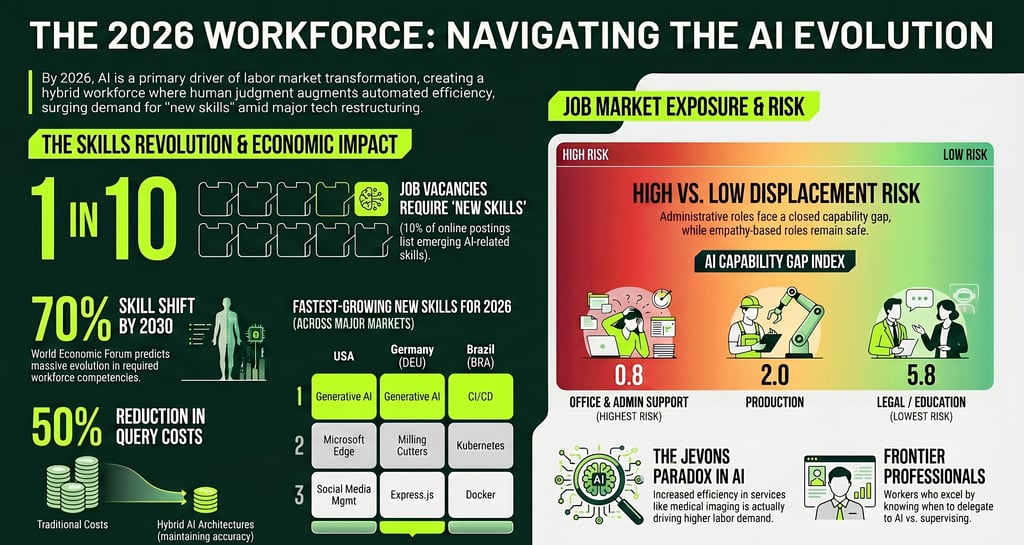
The OECD recently released its "AI Exposure Measure," introducing a quantitative framework that maps the capability gap between current AI models and the requirements of roughly 900 occupations. The smaller the gap, the higher the occupation's exposure to current AI capabilities.
Office & Administrative Support: Scores 0.8 (Highest Exposure). Core tasks like bookkeeping, billing, auditing, and data entry show near-complete alignment with current AI capabilities.
Legal Occupations: Scores 5.8. Highly exposed in document review and contract template drafting, but insulated in high-stakes litigation and complex client strategy.
Community & Social Service: Scores 6.4 (Lowest Exposure). Requires empathetic counseling and unstructured community support that AI cannot replicate.
The OECD findings show that office and administrative support workers face the most immediate displacement risk. But what happens if AI makes a job cheaper and faster? Does the job disappear?
Enter The Jevons Paradox. Dr. Jeffrey Roach, Chief Economist at LPL Financial, argues that as a technological advancement increases the efficiency of a resource, the unit cost of that resource falls, which triggers a massive surge in market demand, ultimately increasing the total consumption of that resource.
For example, diagnostic imaging centers have used AI to automate large portions of the analytical image-reading load. Instead of firing everyone, these centers have actually increased their hiring of human technicians to handle the massive surge in diagnostic demand driven by lower operational service costs.
However, this efficiency gain is counterbalanced by a "cognitive overhead penalty" in complex tasks. Research evaluating developers using AI tools found that while routine tasks are accelerated, completion times for complex, context-heavy programming tasks actually increased by 19%. Managing, auditing, and debugging AI-generated outputs can create substantial cognitive overhead.
This means that the nature of work is fundamentally shifting. You are no longer paid just to do the task; you are paid to manage the AI doing the task, audit its work, and apply human judgment. If your job does not require critical thinking, quality control, or deep human empathy, it is not a safe job.
Part 4: The Rise of AI Agents and the "GenAI Divide"
The architecture of enterprise AI is shifting from basic conversational chatbots to fully autonomous agentic workforces. We are moving beyond tools that just answer questions into systems that execute multi-step workflows.
For instance, Zendesk recently announced it is completely discontinuing its traditional chatbot services in favor of a fully autonomous service workforce. Microsoft has announced the general availability of computer-using agents within Copilot Studio, allowing agents to directly navigate user interfaces to automate legacy workflows.
But here is the reality check: Corporate integration of AI is failing miserably at scale.
While 88% of organizations regularly utilize AI in at least one business function, only 23% are scaling an agentic system anywhere in their enterprise. In any single department, the scaling ceiling remains at or below 10%. Gartner forecasts that more than 40% of agentic AI projects will be canceled before 2027 due to unclear ROI, escalating costs, and inadequate risk controls.
Researchers call this the "GenAI Divide"—a state where 95% of corporate AI pilots fail to reach full production. The organizations capturing real value (the 6% of "AI high performers") are those that fundamentally redesign workflows from the ground up rather than just bolting AI onto old processes.
Why does this matter to you? Because it proves that giant corporations are slow, bloated, and struggling to adapt. This creates a massive, unprecedented window of opportunity for the agile, independent creator.
Part 5: Escaping the Matrix – AI Automation Tools for Solopreneurs
You do not need a massive corporate budget to wield the power of artificial intelligence. In fact, as a solopreneur, your lack of bureaucratic red tape is your greatest advantage. You can adopt and deploy AI faster than a Fortune 500 company ever could.
This is why I preach the gospel of self-reliance. When you master AI automation tools for solopreneurs, you effectively clone yourself. You become a one-person agency capable of doing the work of ten people.
Here is how you leverage the current landscape to become completely independent:
Stop Competing on Routine Execution: If your freelance service is just basic data entry, standard copywriting, or routine bookkeeping, you are competing against an AI that costs $3 per million tokens (like Claude Sonnet 4.6). You will lose. You must elevate your service to focus on strategy, empathy, and highly contextual problem-solving.
Master Agentic Workflows (Level 1 and Level 2 Autonomy): You don't need fully autonomous self-improving AI (Level 5) to win. The dominant pattern in 2026 is "Tool-augmented" (Level 1) and "Bounded autonomy" (Level 2). Use tools where the AI runs a multi-step process in a sandbox, and you review the output at the end. You are the director; the AI is your staff.
Deploy Specialized AI for Heavy Lifting: Use high-capability models like Claude Opus 4.7 for complex reasoning, Claude Sonnet 4.6 as your everyday workhorse for content and coding, and low-cost models like Claude Haiku 4.5 for high-volume triage and data routing.
Embrace the New Human Skillset: As AI expands what people can do, it raises the premium on good judgment. The most important skills in 2026 are quality control of AI output (cited by 50% of surveyed advanced users) and critical thinking (46%). Treat AI output as a starting point, not a final answer. You must stay responsible for the thinking.
By adopting these tools, you insulate yourself against the whims of a corporate employer. If a company restructures and lays off 10,000 people, it doesn't affect you. If the government changes H-1B visa policies, it doesn't affect you. Your income is tied directly to the value you generate in the open market using your AI-augmented skillset.
Conclusion & The Chilling Truth Revealed
I promised you a horrifying statistic at the beginning of this article. A number so disturbing it completely shatters the illusion of the "safe" modern career path.
For the last two decades, society has told young people: "Learn to code. Tech is safe. Software engineering is bulletproof." Parents mortgaged their homes to send their kids to elite computer science programs.
Here is the reality check: According to Stanford University’s 2026 AI Index, employment among software developers aged 22-25 fell approximately 20% since 2024.
Let that sink in. The disruption is targeted and just beginning. The very creators of the technology—the junior developers who write the code—are being replaced by the AI they helped bring into existence. Because AI tools like GitHub Copilot and Claude Code can now handle routine coding, companies no longer need armies of entry-level developers. The "safest" job in the world has suffered a 20% employment collapse in just 24 months.
If the tech industry is willing to hollow out its own entry-level foundation, what do you think they will do to accountants, marketers, administrators, and customer service reps?
No job is safe. No industry is immune. The corporate ladder is broken.
But you do not have to be a victim of this transition. You have a choice. You can wait for the inevitable restructuring, hoping you aren't part of the 17% of workers caught in the next layoff wave. Or, you can take radical ownership of your life.
Learn the tools. Master the AI automation tools for solopreneurs. Redefine your value around critical thinking, human empathy, and strategic direction. Build your own business, serve your own clients, and become truly independent.
The future belongs to the agile, the independent, and the brave. Make the leap today.
— Buzz Leaps
--------------------------------------------------------------------------------
References:
Bank of Canada notes AI is transforming tasks, not eliminating jobs wholesale.
AI adoption in Canada shows 30% in finance vs. 1.5% in hospitality.
57% of young Canadians say AI is affecting long-term career choices.
Global Capability Centres in India slash hiring plans by 30% to 50%.
TCS reduces entry-level intake by 37.5%.
The traditional Indian IT model built on labor arbitrage is eroding.
India graduates over 1 million engineers annually, but pipeline is narrowing.
110,000 tech employees laid off globally across 144 companies in 2026.
H-1B visa holders face a brutal 60-day window to secure new employment.
Premium on quality control (50%) and critical thinking (46%) over AI outputs.
UCL survey: Less than 10% of Chinese respondents worry about AI job prospects.
China pitches AI as a source of new jobs and productivity.
Massive structural reallocation of capital; $700 billion AI infrastructure pivot.
Intuit cuts 17% of global workforce (3,000 jobs); Meta cuts 8,000 jobs.
Oracle executes roughly 30,000 layoffs globally.
Shift from conversational chatbots to autonomous agentic workforces.
Zendesk discontinues chatbot services for a fully autonomous workforce.
Microsoft Copilot Studio computer-using agents generally available.
Only 23% of organizations scaling agentic systems; single-department scaling below 10%.
Global labor market pressures and policy responses.
U.S. entry-level openings up 18%, but hiring velocity flatlines at 3% growth.
Only 19% of entry-level job seekers report feeling very confident; 44% prioritize job security.
Indian professionals face strict 60-day H-1B visa windows amid layoffs.
Canadian AI adoption highly polarized by sector.
26% of university-educated workers in Canada actively building new AI skills.
Youth unemployment in Canada at 13.8%; 49% reconsidering career paths.
Algorithmic management tools utilized by 79% of European firms.
Employed EU individuals save 7.4 hours/month; 4.6% perceived efficiency gain.
EIB study: AI adoption increases labor productivity by 4%.
Australian unemployment at 4.1%; focus on job augmentation.
Only 4% of Australian roles highly exposed to automation.
Nearly one in three Australians fears job disappearance due to AI.
CBA invests $2.4 billion annually; launches $90 million Future Workforce Program.
96% of surveyed Chinese workers report using AI weekly.
China accounts for 85% of global humanoid installations in 2025.
24 million humanoids projected by 2035 to address 37 million worker shortfall in China.
Generative models handle basic code reviews, destroying offshore advantages.
TCS cuts entry-level hiring by 37.5%.
India graduates 1 million engineers; specialized AI roles number only in thousands.
OECD AI Exposure Measure released May 26, 2026.
Office/Administrative support scores 0.8 (highest exposure); Community Service scores 6.4 (lowest exposure).
OECD findings show clerical work faces most immediate displacement risk.
The Jevons Paradox: Increased efficiency can ultimately expand labor demand.
Diagnostic imaging centers increase hiring; cognitive overhead penalty in complex programming slows tasks by 19%.
Gartner forecasts >40% of agentic AI projects will be cancelled by 2027.
The "GenAI Divide": 95% of corporate pilots fail to reach full production.
Only 6% of organizations capture significant EBIT impact through fundamental workflow redesign.
Level 1 and Level 2 Autonomy are the dominant enterprise patterns today.
Level 5 Autonomy (self-improving agents) remains ≈0% in broad production.
Claude Opus and Sonnet capabilities and pricing metrics.
Claude Haiku low-cost model metrics.
Employment among software developers aged 22-25 fell ~20% since 2024.
EU AI Act high-risk AI obligations and Article 73 incident reporting take effect August 2, 2026.
"AI washing" definition in relation to stock price manipulation.
54% of Europeans use AI technologies.
Employed Europeans save 7.4 hours/month (4.6% efficiency gain).
Assuming full conversion, this leads to an estimated 0.94% gain in Total Factor Productivity.
Fear of AI-driven job displacement highest among lower-income, younger individuals.
AI saves tradies 5-10 hours/week on automated quoting and smart scheduling.
Only 4% of Australian jobs are highly exposed to automation.
Reserve Bank of Australia reports most firms expect AI to be labor-saving.
Roles at highest risk include office clerks, receptionists, and bookkeepers.
80% of Australian small businesses use AI or plan to adopt it within two years.
Atlassian announces 500 job cuts in Australia (part of 1,600 globally).
WiseTech and Block cut jobs citing AI efficiencies.
Gartner HR adviser suspects AI is often cover for other financial pressures.