<script async src="https://pagead2.googlesyndication.com/pagead/js/adsbygoogle.js?client=ca-pub-7001450216977829"
crossorigin="anonymous"></script>
The AI Jobscalypse: How to Automate Repetitive Tasks with AI
The traditional job market is no longer safe against the AI "capital swap" . Learn the truth behind global layoffs and discover how to automate repetitive tasks with AI to build true career independence.
HOW TO AUTOMATE REPETITIVE TASKS WITH AI,AI TOOLS, AI AGENTS, AI AUTOMOTION, AI TRENDSGLOBAL EMPLOYMENT TRENDS 2026, AI JOB IMPACT, TECH LAYOFFS 2026, FUTURE OF WORK, JOB MARKET TRENDS WORLDWIDE, AI REPLACING JOBS, HIRING SLOWDOWN 2026, EMPLOYMENT CRISIS GLOBAL, WORKFORCE TRANSFORMATION, JOBS AND AI
5/20/20268 min read
The AI Jobscalypse and the Blueprint for True Independence
Did you know that there is a silent, invisible force sweeping the globe right now that is mathematically projected to erase a staggering $1.2 trillion in annual salaries, wiping out the livelihoods of millions of highly educated workers without a single traditional economic recession or market crash? This isn't a theory; it is happening right now under our noses. I will reveal exactly what this horrifying force is—and the terrifying paradox it creates for global economies—at the end of this guide.
Hello, my friends. I am Buzz Leaps, author and publisher of motivational books, and I am here to tell you a hard truth: the traditional job market is no longer safe. Whether it is artificial intelligence, war, government decisions, or volatile company policies, relying on a standard 9-to-5 job for your survival is a risk you can no longer afford to take. My mission is to encourage you to take up skills that will make you truly independent.
Today, we are going to dive deep into the global structural rewiring of the labor market in 2026. We will explore how AI automation and autonomous agents are reshaping employment in the USA, Canada, Europe, Australia, China, and India. By understanding these massive shifts, you can learn to leverage these tools yourself, understand how to automate repetitive tasks with AI, and break free from a fragile corporate system.
The Great "Capital Swap": How Silicon Valley is Trading Humans for Hardware
We are currently witnessing a profound structural transformation in the global labor market that economists are calling a strategic "capital swap". Corporate expenses historically allocated for human labor are being aggressively traded for massive capital expenditures in AI infrastructure. In the first four months of 2026 alone, over 61,000 global workers lost their jobs directly to AI-related cuts. Overall, the tech sector has seen over 128,000 workers let go across hundreds of events this year.
Why is this happening? Because the same companies cutting their payrolls are pouring an estimated $725 billion into AI capital expenditures this year, up from $410 billion last year.
Take Meta Platforms as a prime example. Mark Zuckerberg’s company recently initiated an 8,000-person layoff, roughly 10% of its global workforce, to help fund up to $145 billion in AI infrastructure. Instead of simply cutting costs, Meta reassigned approximately 7,000 surviving employees into new AI-focused divisions—such as the Agent Transformation Accelerator—while actively flattening its management structure. The goal is to bake "AI native design principles" directly into the organization, eliminating the mid-level human layers that used to manage processes.
This shift is incredibly stressful for traditional employees. Inside Meta, over 1,000 workers signed a petition opposing the "Model Capability Initiative"—a software tool that monitors mouse and keystroke data to train internal AI systems to replicate human workflows. But this corporate vulnerability is exactly why you must build your own independence. You cannot allow a corporation to harvest your skills and then discard you.
Mastering the Shift: How to Automate Repetitive Tasks with AI
The technology has evolved rapidly from simple software into the era of "agentic AI." In previous decades, software was merely a tool for a human decision-maker. Today, AI agents are active cognitive workers capable of reasoning, planning, and executing complex workflows autonomously.
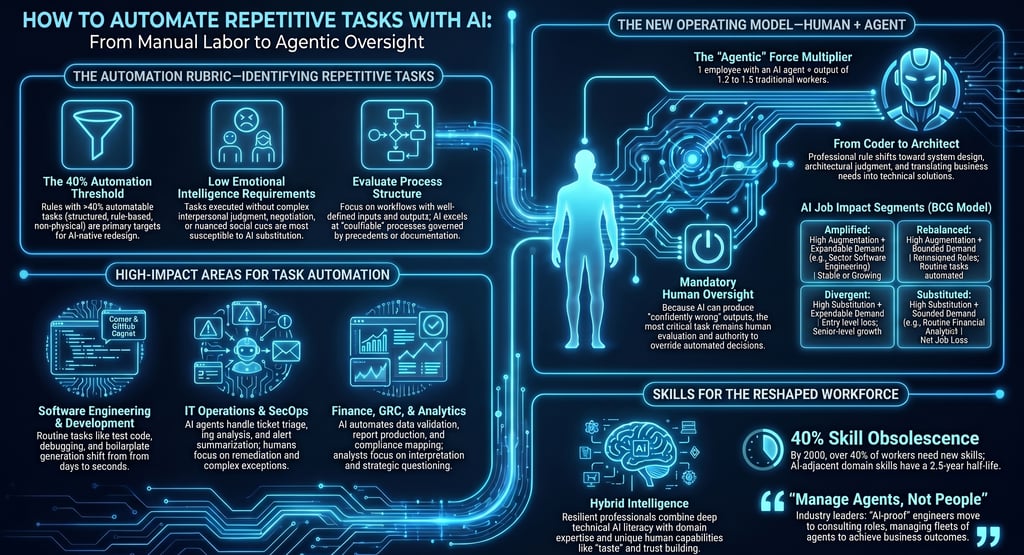
For the independent entrepreneur or the forward-thinking professional, understanding how to automate repetitive tasks with AI is your ultimate competitive advantage. Companies are already seeing the benefits: in fields like compliance, accounting, and engineering, one employee armed with an AI agent is now producing the output of 1.2 to 1.5 people. Tools like Cursor, Claude Code, and GitHub Copilot are fundamentally changing software development. Over 90% of traditional developers now work slower than leading AI coding systems on routine tasks.
This is birthing a new class of highly-valued professionals: the "Frontier Professionals". According to Microsoft data, these advanced users don't just use chatbots; they build multi-agent systems, routinely rethink workflows, and refuse to outsource their critical thinking. They treat AI as a force multiplier. For those building their own independent businesses, leveraging these agents to automate administrative tasks, data entry, and basic coding can give you the output of a full agency without the payroll costs.
The North American Divide: Infrastructure Booms and Succession Crises
The United States: The Blue-Collar Boom and White-Collar Bust In the USA, the labor market is sharply bifurcating. On one side, the massive computing demands of AI have triggered a boom in physical infrastructure. The U.S. will need to fill 500,000 new jobs by 2030 for construction workers, electricians, and engineers to build data centers. On the other side, entry-level white-collar job postings (like basic coding and IT) are slipping, while postings for senior-level "agent managers" who possess the soft skills to validate AI outputs have jumped. Recruiters are no longer looking for people to do the manual work; they want experienced individuals who can act as the "human glue" managing autonomous systems.
Canada: The Skills Deficit and Youth Disruption Canada is facing an acute skills deficit. A recent survey found that while 77% of Canadian organizations are deploying agentic AI, only 3% have achieved measurable returns. Why? Because the global demand-to-supply ratio for AI Agent Architects is a staggering 8-to-1.
This rapid automation is devastating for Canadian youth, creating what experts call an entry-level "succession crisis". A massive 57% of young Canadians aged 18 to 24 report that AI is impacting their long-term career opportunities, and 49% are reconsidering their career paths. By automating away entry-level roles, companies are destroying their own talent pipelines. If you are young, this is your wake-up call: do not rely on corporate ladders. Build your own skills, offer your own independent consulting, and become the master of the technology.
Europe and Australia: Regulation, "Job Hugging," and Reskilling
Europe: The Regulatory Shield and the Temporary Hiring Boost In Europe, the employment landscape is heavily shaped by regulatory oversight, notably the EU AI Act. Lawmakers have just agreed on a "Digital Omnibus" package that pushes back the compliance deadline for high-risk AI systems used in HR (such as recruitment and performance monitoring) from August 2026 to December 2027. This gives businesses a 16-month delay to ensure their AI tools undergo mandatory risk assessments and bias testing, and guarantee human oversight.
Interestingly, the European Central Bank reports that right now, intensive AI adoption is not driving net employment losses in Europe. In fact, European firms making significant use of AI are currently 4% more likely to hire additional staff in the near term. This is because companies desperately need humans to integrate these systems and redesign workflows. However, this may be a short-term buffer; the Ifo Institute notes that 25% of German firms expect AI to result in job cuts within the next five years.
Australia: Leading in Governance, Lagging in Productivity Australia has taken a very cautious approach. The country leads the world in responsible AI governance, with 31% of businesses focused on compliant AI policies, compared to a global average of 26%. However, this comes at the cost of productivity gains, with only 35% of Australian organizations prioritizing automation-driven productivity.
Australian workers are currently engaging in "job hugging"—prioritizing security and clinging to their current roles amid economic uncertainty. Recognizing this stagnant talent pool, Australian CEOs are actively favoring reskilling over layoffs. Only 20% of leaders rank reducing hiring as a top priority, opting instead to redesign roles and upskill staff.
The Asian Powerhouses: China's Legal Walls and India's Structural Pivot
China: Making AI Layoffs Illegal In one of the most fascinating developments globally, Chinese courts have established firm legal barriers against AI-driven human replacement. In landmark rulings, courts declared that companies cannot unilaterally fire workers or cut their salaries just because an AI can perform their role more cheaply. The courts view adopting AI as a voluntary business decision, meaning firms must retrain and reassign affected workers rather than transferring the financial burden onto them.
This judicial protection aims to stop the corporate practice of "skill distillation"—where companies monitor employee keystrokes and workflows to build digital clones of their staff before firing them. Furthermore, the Chinese government is aggressively using AI algorithms to help place a record 12.7 million university graduates into the urban labor market, using the technology as a national matchmaking tool.
India: The $300-Billion IT Crisis India’s massive IT outsourcing industry is facing a severe structural challenge. For decades, the sector thrived on a "labour arbitrage" model—throwing massive amounts of cheap human labor at digital problems. But with Generative AI, global clients are moving toward a "services as software" approach.
This has resulted in widespread anxiety and "silent layoffs." Global firms like Oracle recently cut around 12,000 jobs, heavily impacting its India offices, while IT giants like TCS and Infosys have drastically reduced fresh graduate hiring. Net hiring at India’s top five IT firms fell to just 17 individuals over a nine-month period, compared to 18,000 the previous year. Indian engineers are realizing that basic coding and software testing are no longer safe career paths.
Who is Safe? The BCG Labor Disruption Segments
If you are looking to build a resilient, independent career, you must understand which tasks are safe and which are doomed. The Boston Consulting Group (BCG) estimates that 50% to 55% of all U.S. jobs will be significantly reshaped by AI, while 10% to 15% will be outright eliminated over the next few years. They break the labor market down into specific segments:
Amplified Roles (5% of jobs): Human capabilities are augmented, and demand expands. Examples include senior software engineers and advisory lawyers. AI makes them faster, and the market demands more of their high-level output.
Rebalanced Roles (14% of jobs): Headcount stays steady, but the work changes. Think of content marketing or academic research. Routine tasks automate, but the human focuses on strategy, omnichannel campaigns, and hypothesis formation.
Divergent Roles (12% of jobs): AI substitutes human tasks, but demand is expandable. Entry-level roles vanish, but senior roles grow. Insurance sales and IT support fall here. Basic lead qualification is automated, but complex advisory roles grow.
Substituted Roles (12% of jobs): This is the danger zone. When demand is capped and AI can do the job, humans lose. Call center representatives and basic financial analysts fall here. Efficiency gains convert directly into net job losses.
Enabled Roles (23% of jobs): AI is embedded to improve efficiency, but the core role remains human-led, often requiring physical presence (like clinical assistants).
Limited-Exposure Roles (34% of jobs): Jobs that are highly contextual, relationship-driven, or physical, such as teachers and physicians. AI assists, but cannot reshape the core function.
The Reveal: The "Ghost GDP" and The AI Layoff Trap
At the beginning of this post, I mentioned a horrifying statistic: a projected $1.2 trillion erasure in annual salaries. What is the suspenseful force behind this?
It is a macroeconomic disaster known as The AI Layoff Trap, leading to a terrifying scenario economists call "Ghost GDP".
Here is the context: Corporations are currently firing workers to boost short-term profit margins. However, white-collar employees represent approximately 50% of the aggregate workforce in advanced economies and drive roughly 75% of all discretionary consumer spending. If companies replace their human workers with autonomous AI agents, household disposable income plummets.
When wages disappear, consumer spending in retail, housing, and travel collapses. You end up in a fatal economic paradox: extreme corporate productivity and zero consumer demand. The machines are producing goods and services flawlessly, but the humans have no money to buy them. This is "Ghost GDP"—an economy that looks highly efficient on a server rack but is completely hollowed out in the real world.
Your Path to Independence
My friends, the traditional social contract is broken. Companies are literally stripping your operational habits, keystrokes, and decision-making patterns to build "digital employees" that will take your job. The EU is trying to regulate it, China is trying to ban it, and the US is letting the free market rip. But you cannot wait for a government to save you.
You must become independent. Stop relying on a job that can be erased by an algorithm, a macroeconomic shock, or a 4:00 AM corporate email.
Upskill Aggressively: Become the master of the technology. Learn how to automate repetitive tasks with AI in your own independent ventures.
Build Your Own Enterprise: Use the very same AI agents that corporations use, but use them to scale your own one-person business. If an AI agent can do the work of five junior marketers, build a marketing agency where you are the CEO and the agents are your staff.
Focus on "Human Glue" Skills: Shift your focus away from manual, repeatable tasks toward high-level strategy, human empathy, complex negotiation, and architectural design.
The world of work will never be the same. The AI revolution is here, and it is reshaping the globe. Don't be a casualty of the Capital Swap. Be the architect of your own future. Stay hungry, stay independent, and leap forward.