<script async src="https://pagead2.googlesyndication.com/pagead/js/adsbygoogle.js?client=ca-pub-7001450216977829"
crossorigin="anonymous"></script>
The 2026 Job Squeeze: AI Workflow Automation vs Traditional Automation
Is your job safe? Discover the shocking 2026 labor market realities and learn the crucial differences of AI workflow automation vs traditional automation to thrive.
AI WORKFLOW AUTOMATION VS TRADITIONAL AUTOMATION,GLOBAL EMPLOYMENT TRENDS 2026, AI JOB IMPACT, TECH LAYOFFS 2026, FUTURE OF WORK, JOB MARKET TRENDS WORLDWIDE, AI REPLACING JOBS, HIRING SLOWDOWN 2026, EMPLOYMENT CRISIS GLOBAL, WORKFORCE TRANSFORMATION, JOBS AND AIAI TOOLS, AI AGENTS, AI AUTOMOTION, AI TRENDS
5/23/20269 min read
Did you know there is a terrifying, data-backed projection floating around the top echelons of Silicon Valley right now? It predicts an imminent shift that could completely wipe out a massive chunk of specific professional jobs in just a few short years, potentially pushing unemployment for this group into double digits. Millions of people who think they played by the rules and secured a "safe" desk job will suddenly find their security erased. I will reveal the exact source and nature of this horrifying statistic at the very end of this post, but for now, I want you to wake up.
I am Buzz Leaps, author and publisher of motivational books, and my mission is to empower you to stop relying on "safe" jobs. The truth is, traditional employment is no longer safe; it is heavily influenced by rapid AI advancements, global conflicts, government decisions, and unpredictable corporate policies. The only true security lies in acquiring the independent skills necessary to adapt and thrive in an unpredictable world.
Welcome to the new era of work. Let’s dive into what the 2026 global labor market actually looks like, how artificial intelligence is reshaping everything, and how you can take control of your destiny.
The Illusion of the "Safe" Job
For generations, we were sold a dream: go to school, get a degree, find a corporate or government job, and ride it out until retirement. But as we look at the global landscape in 2026, that dream is visibly fracturing. The global labor market presents a surface-level narrative of resilience that masks deep structural fragility and shifting power dynamics. While the global unemployment rate is projected to remain at 4.9%, progress in job quality has stalled, and the broader global jobs gap—capturing people who want work but cannot find it—is projected to reach a staggering 408 million.
You cannot hand your financial independence over to an employer who is at the mercy of macroeconomic shocks and technological revolutions. Today, business leaders are designing roles, teams, and workflows on the assumption that humans and AI agents will work together. As organizations adopt autonomous AI, traditional corporate ladders are breaking down. In fact, Gartner predicts that through 2026, 20% of organizations will use AI to flatten their organizational structure, eliminating more than half of current middle management positions.
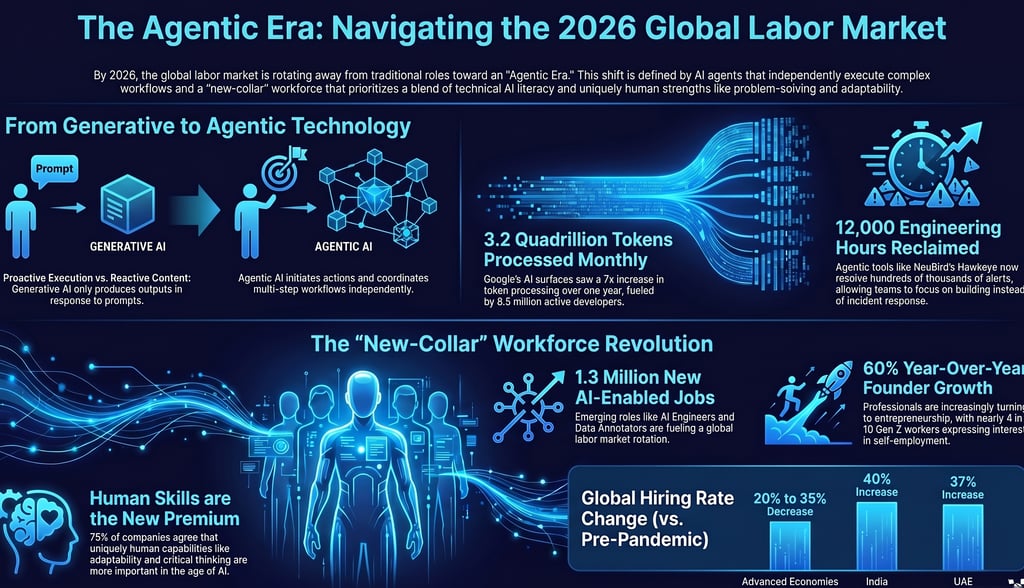
If you are waiting for a company to protect your career, you are playing a losing game. The professionals who are thriving today are those turning to entrepreneurship and independent work. LinkedIn members adding "founder" to their profiles grew by 60% year over year globally, and "creator" grew nearly 90%. People are realizing that self-reliance is the ultimate career insurance.
Understanding the Shift: AI Workflow Automation vs Traditional Automation
To become truly independent, you must understand the tools that are reshaping the economy. The most critical technological shift happening right now is the evolution from basic automation to agentic AI. If you want to future-proof your skills, you must master AI workflow automation vs traditional automation.
Traditional automation is rule-based and rigid. It relies on explicit "if X, then Y" programming. It is highly effective for repetitive, predictable tasks like basic bookkeeping, data entry, and standard invoice processing. However, traditional automation breaks down the moment it encounters an exception, ambiguity, or a task requiring contextual judgment.
AI workflow automation, driven by agentic AI, is fundamentally different. Agentic AI refers to systems composed of one or multiple coordinated AI agents that can break down tasks, collaborate, use external tools, and pursue goals over extended periods with limited human supervision. Rather than just generating content, agentic AI can take proactive action.
When we look at AI workflow automation vs traditional automation, the difference is autonomy and adaptability. For instance:
Customer Support: Traditional automation uses chatbots with scripted decision trees. Agentic AI, like the embedded agent "Fin," actively resolves 40.1% of all actionable tickets entirely without human intervention by understanding context and taking appropriate system actions.
Software Engineering: Traditional automation might run basic pre-written tests on code. Agentic AI platforms—like Google's Antigravity or OpenAI's Codex—can spin up sandboxed subagents, autonomously find and fix vulnerabilities, run unit tests, and present completed code repositories for human review.
Security: Microsoft’s Multi-model Agentic Scanning Harness (MDASH) uses over 100 specialized AI agents that independently discover, debate, and prove exploitable software bugs end-to-end.
The takeaway for you: Do not just learn how to use software; learn how to manage and orchestrate AI agents. The human role is transitioning from executing tasks to governing, auditing, and orchestrating AI workflows.
The Squeeze on the Workforce: Who is Losing and Who is Winning?
The impact of AI on jobs is not a simple story of mass unemployment; it is a story of profound restructuring. Over the next two to three years, 50% to 55% of jobs in the US will be reshaped by AI.
According to global research, AI's impact categorizes jobs into several distinct buckets:
Substituted Roles (12% of jobs): Where demand is capped and AI directly substitutes for human workers, resulting in net job losses. This includes routine data entry, basic customer support, and standard financial analysis.
Rebalanced Roles (14% of jobs): AI augments the work, automating routine tasks while complex responsibilities expand. Workers here must rapidly upskill to handle higher-value activities.
Divergent Roles (12% of jobs): AI substitutes for human tasks but overall demand remains expandable. In these roles, entry-level and junior positions are highly exposed to automation in the short term, shrinking traditional career pathways.
Amplified Roles (5% of jobs): AI augments human capabilities and demand expands, placing humans at the center of value creation (e.g., complex software engineering and high-level legal advisory).
The squeeze is hitting the bottom and the middle of the corporate ladder. AI agents are increasingly handling routine cognitive tasks like drafting, coding, and data entry, creating an "entry-level bottleneck". Because AI can perform the work of junior developers or junior analysts, traditional entry pathways are shrinking.
At the same time, this creates a massive opportunity for independent professionals. If you build your own skills, you no longer need an entry-level job at a corporation to gain leverage. You can use AI workflow automation to produce the output of an entire team, operating as a high-value solo entrepreneur or consultant.
The Global Job Market Landscape in 2026
To understand how to navigate this, we must look at the global realities. The AI revolution is affecting different regions in unique ways.
The United States: An Infrastructure and Tech Boom
The U.S. labor market is stabilizing with a steady 4.3% unemployment rate, but hiring is highly concentrated. While white-collar tech and federal government roles have seen contractions, there is a massive physical infrastructure boom. The domestic energy and data center construction required to power the AI revolution has created 216,000 new construction jobs since 2022, and the U.S. will need to fill 500,000 net new skilled technical jobs by 2030. On the digital front, 1.3 million new AI-enabled jobs have emerged globally, heavily benefiting U.S. roles like AI Engineers and Data Annotators.
Canada: High Adoption, Low ROI, and Youth Anxiety
In Canada, 77% of organizations are currently deploying agentic AI systems, but a staggering reality remains: only 3% have achieved a measurable financial return. The primary obstacle is a severe talent shortage. Canadian businesses simply do not have enough professionals who know how to strategically implement these tools. Meanwhile, 46% of employed Canadians say AI has impacted their long-term career, and young Canadians (aged 18-24) are feeling immense pressure, with 49% of those impacted reconsidering their career paths. The lesson here? If you can bridge the gap between AI technology and actual business value, you will be unstoppable.
Europe: Regulatory Delays and the Push for AI Literacy
The European labor market is dealing with a low-growth, high-inflation squeeze. However, Europe's stringent regulatory environment is creating unique opportunities. EU lawmakers recently delayed the enforcement of "high-risk" workplace AI obligations under the EU AI Act to late 2027. This revised Act legally mandates basic "AI literacy" for all employees interacting with automated systems. For independent educators, consultants, and tech trainers, Europe presents a massive market for upskilling and compliance training.
Australia: The Blue-Collar Boom and Graduate Crisis
Australia is experiencing a fascinating dichotomy. The country faces chronic skilled labor shortages in construction, trades, and healthcare. In these sectors, AI is not taking jobs; it is acting as a lifeline by automating administrative tasks so humans can focus on physical work and patient care. However, traditional university graduates are facing a crisis. A Senate inquiry is currently investigating how AI is automating the entry-level jobs that graduates used to rely on. Relying solely on a university degree without practical, independent skills is becoming a dangerous gamble.
India and China: The Next Frontiers of AI Talent
China is seeing a massive state-backed AI hiring boom, with 26.2% of all job openings at new economy companies directly related to AI roles. In India, the growth is staggering: India leads the world with a 59.5% year-over-year surge in AI engineering job postings. More importantly, this talent is decentralizing from major tech hubs into tier-2 cities and is being heavily applied to traditional industries like manufacturing, where AI engineering talent has grown fourfold.
The "New Collar" Workforce and the Human Skills Premium
If traditional jobs are vanishing, what is actually in demand? We are entering the "new-collar" era, an emerging workforce that blends knowledge work, advanced technical skills, and distinctly human strengths.
As routine technical execution becomes automated, the market is placing an unprecedented premium on capabilities that machines cannot replicate. The human role is transitioning from execution to governance, critical evaluation, and emotional intelligence.
According to Randstad's analysis of 35 million job postings, demand for uniquely human skills has skyrocketed:
Emotional Intelligence: Demand is up by 173%.
Creativity: Demand is up by 168%.
Problem Solving: Demand is up by 35%.
Critical Thinking and Ethical Judgment: Demand is up by 17% and 11%, respectively.
If you combine these human skills with technical AI fluency, you become the most valuable asset in the modern economy. Professionals who are "AI-fluent" are securing promotions 3.5 times faster than their peers. Workers with advanced AI skills are earning wage premiums up to 56% higher than peers in the same roles.
Do not compete with AI on raw execution. Compete on context, empathy, creativity, and relationship-building. As an independent professional, your ability to understand a client's core problem, apply critical thinking, and use AI workflow automation to deliver the solution is your ultimate competitive advantage.
Buzz Leaps' Blueprint for True Independence
My friends, the era of handing your life over to a corporation and hoping for the best is over. Jobs are vulnerable to artificial intelligence, geopolitical wars, economic inflation, and the whims of corporate boards. To secure your future, you must become an independent, adaptable operator. Here is your blueprint:
1. Stop Relying on Degrees; Start Building Portfolios Degrees are losing their protective armor. The data shows that university-educated workers actually feel the impact of AI disruption most acutely. Employers are shifting toward skills-based hiring because the technology is moving too fast for traditional curricula to keep up. Build a portfolio of real-world projects that demonstrate your ability to solve complex problems.
2. Master AI Delegation, Not Just Execution The future belongs to the "human sandwich". You must learn how to define an objective, delegate the execution to AI agents, and then rigorously audit the output for quality and ethics. You are no longer just a worker; you are a manager of digital systems.
3. Lean Into Your Humanity Machines do not possess empathy, nor can they build deep, trusting relationships with human beings. Whether you are consulting, selling, teaching, or creating, double down on your emotional intelligence and critical thinking. The more AI generates generic "slop," the more the market will crave authentic, differentiated, human-driven insights.
4. Become an Independent Contractor More than half of technology managers plan to expand their use of contract talent. Why? Because AI capability requirements change faster than traditional employment structures can accommodate. Take advantage of this. Offer your services as an independent consultant or freelancer. By diversifying your client base, you insulate yourself from the risk of a single employer laying you off.
The Horrifying Truth Revealed
At the beginning of this post, I promised to reveal a terrifying statistic that is quietly circulating among the top leaders in the tech industry. Here it is:
Dario Amodei, the CEO of Anthropic (one of the leading frontier AI companies in the world), has explicitly warned that AI could eliminate 50% of all entry-level white-collar jobs within the next five years, potentially pushing U.S. unemployment to 10–20%.
Let that sink in. The architects building these systems are telling us, point-blank, that half of the foundational corporate jobs that built the middle class could vanish in the blink of an eye. We are already seeing companies aggressively cut junior roles and flatten middle management to reallocate budgets toward AI investments.
This is not a drill, and it is not science fiction. The decoupling of human labor from routine cognitive execution is happening right now.
But you do not have to be a victim of this statistic. You have a choice. You can cling to the old way of doing things, hoping your job is spared, or you can embrace the future. Learn the tools. Master AI workflow automation. Cultivate your uniquely human skills. Step out of the illusion of corporate safety and build your own independent, resilient path.
The future belongs to those who take action today.
Stay independent. Stay resilient. – Buzz Leaps