<script async src="https://pagead2.googlesyndication.com/pagead/js/adsbygoogle.js?client=ca-pub-7001450216977829"
crossorigin="anonymous"></script>
The 2026 AI Paradox: Layoffs, Skyrocketing Costs, and the Global Race for Regulation
The global digital economy in 2026 has reached a bewildering inflection point. As artificial intelligence shifts from experimental chatbots to autonomous, action-taking agents, the global workforce and regulatory landscape are experiencing seismic shocks. We are living through a paradoxical era: corporations are shedding human labor at an unprecedented scale to fund AI infrastructure, yet simultaneously discovering that these AI agents can cost significantly more to run than the humans they replaced . Meanwhile, governments are scrambling to erect guardrails, from the European Union’s sweeping rights-based legislation to Beijing blocking billion-dollar international tech acquisitions . In today’s deep-dive report, we break down the latest global research, hiring trends, technological bottlenecks, and the regulatory battles defining late April 2026.
GLOBAL EMPLOYMENT TRENDS 2026, AI JOB IMPACT, TECH LAYOFFS 2026, FUTURE OF WORK, JOB MARKET TRENDS WORLDWIDE, AI REPLACING JOBS, HIRING SLOWDOWN 2026, EMPLOYMENT CRISIS GLOBAL, WORKFORCE TRANSFORMATION, JOBS AND AIJOBS, SALARY, INCREMENT, AI JOBS, JOB NEWS, JOBS NEWS TODAY, EMPLOYMENT MARKET,
4/27/20268 min read
The Great Corporate Pivot: Mass Layoffs to Fund the AI Machine
The last two years have seen a relentless wave of corporate downsizing across almost every sector, fundamentally driven by the need to redirect capital toward AI infrastructure and adjust to AI-assisted efficiencies. Since January 1, 2026, more than 1,621 companies have announced mass layoffs, continuing a brutal trend that accelerated through 2024 and 2025.
Just this month, Meta announced up to 8,000 job cuts, scaling back open roles by 6,000 to improve efficiency and focus heavily on generative AI and superintelligence labs. This follows Meta's earlier sweeping reductions of 16,000 employees designed to offset costly AI infrastructure bets. Nike has slashed 1,400 workers primarily in its technology departments as part of its "Win Now" strategy, while Snap reduced its workforce by 1,000 jobs (16% of full-time staff) to ramp up AI adoption. Oracle initiated thousands of job cuts this month, affecting workers globally to fund its artificial intelligence infrastructure push.
This is not confined to the tech sector. Traditional industries are drastically reshaping their organizations:
Automotive: Renault SA is cutting its global engineering workforce by 15% to 20% (up to 2,400 jobs) to mirror the lower costs and shorter development times of Chinese competitors. Volkswagen previously announced a massive restructuring that will shed 50,000 employees by 2030. General Motors laid off over 1,700 workers earlier in the cycle due to slowing EV demand.
Media and Entertainment: The BBC is cutting up to 2,000 jobs, or nearly 10% of its workforce, to tackle financial pressures and save £500m. Omnicom Group laid off over 4,000 employees, noting that the advertising industry faces an existential threat as AI reshapes creative production.
Financial Services: Capital One recently cut over 1,100 workers, and major banks like Morgan Stanley and Citigroup have shed thousands of roles globally.
Companies are justifying these human cuts with the promise of hyper-efficient AI. However, early adopters are colliding with a harsh mathematical reality.
The Cost Reality Check: When AI Agents Cost More Than Human Salaries
A growing body of analysis is completely puncturing enterprise AI's core assumption: that automation is inherently cheaper than headcount. While early studies by Stanford and Carnegie Mellon claimed AI agents could complete tasks 88% faster and at a 96% lower cost, this is only true for routine, well-defined tasks under optimal conditions.
For high-volume, low-complexity customer service workflows, AI is a definitive winner. AI handles routine interactions at $0.25 to $0.50 per contact, compared to $3 to $6 for a human agent—an 85% to 92% cost reduction.
But for complex, multi-step knowledge work, fully loaded agentic AI costs are regularly exceeding equivalent human labor. Once you factor in orchestration infrastructure, oversight workflows, compliance monitoring, and the human hours required to supervise agents through failure states, the arithmetic flips. Token usage consumes a staggering 40% to 70% of an AI operations budget, with output tokens costing up to four times as much as input tokens. API calls add another 15% to 30%.
Because of escalating costs, unclear business value, and inadequate risk controls, Gartner predicts that more than 40% of AI agent projects will be shut down by the end of 2027. Startups that built their unit economics around the assumption of cheap AI labor are facing massive burn rates, forcing tech giants like Anthropic, OpenAI, and Google to slash API pricing. The ultimate lesson for 2026? Replacing a call center agent is easy; replacing a financial analyst drafting a credit memo requires expensive human checkpoints that often turn the ROI negative before the project can scale.
SPONSORED CONTENT: The Cost of Waiting on the Sidelines
While the corporate world reorganizes and algorithms shift, individual professionals are standing at a crossroads. Are you watching the digital economy evolve from the sidelines?
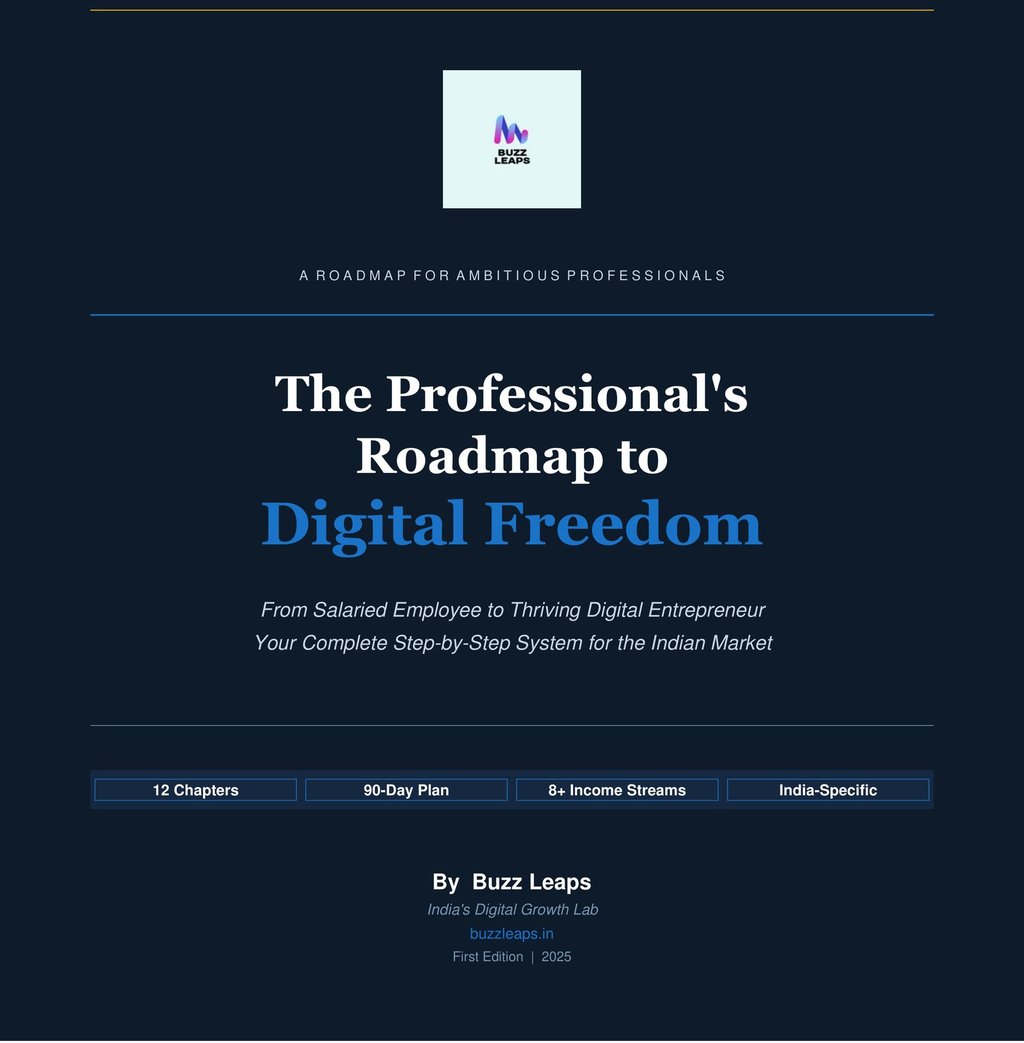
It is time to advertise the ultimate manual for this era: "The Professional's Roadmap to Digital Freedom" by Buzz Leaps.
What you're silently losing right now:
₹40L+: Average digital income left on the table by professionals who knew about it but never started.
3 yrs: Typical head start your peers who started today will have over you if you wait until "the right time".
8 streams: Income channels this book maps out — any one of which could match your current salary within 18 months.
90 days: That's all the structured plan inside asks from you. Not years. Not a career restart. Ninety days.
Two versions of your next 12 months:
Without this book: Still waiting for the right moment to start. Income 100% dependent on one employer. Watching others build audiences & assets. No system, no roadmap, no traction.
With this book: A 90-day action plan from day one. First digital income within weeks. AI tools doing 80% of the content work. A business that runs whether you log in or not.
The cost of waiting: The AI tools, platforms, and strategies in this book are still in an early-mover window. The people who act in the next 6–12 months will build compounding advantages that latecomers simply cannot replicate. This window does not stay open. Markets saturate. Algorithms shift. First movers win.
You are reading this now for a reason. This isn't a book about motivation. It's a manual. And the only question worth asking yourself right now is — can you afford to not have this?
Get your copy today from author and publisher Buzz Leaps: https://9b1c6dd4798a4bb080.v2.appdeploy.ai/
The Talent Shift: Booms in Tier-2 Hubs and the Hunt for 'AI-Proof' Degrees
While overall job markets face turbulence—such as Australia witnessing a 2.9% drop in job ads in March—the demand for specialized AI skills is exploding.
In India, AI hiring has surged 59.5% year-on-year. While Bengaluru remains a global hub, demand is aggressively spreading to tier-2 and tier-3 cities. Hyderabad has emerged as a powerhouse, seeing over 51% growth in AI engineering hiring, while Vijayawada boasts over 45.5% growth. Large enterprises are driving this, but SMBs are rapidly catching up, hunting for talent proficient in AI Agents, AI Productivity, and Azure AI Studio.
Governments are also intervening to prep their youth for the transition. Canada has launched a C$23.8 million funding initiative through its Digital Skills for Youth (DS4Y) program, aimed at providing post-secondary graduates with work experience in emerging fields like AI, cybersecurity, and big data.
However, among college students, anxiety is at an all-time high. A staggering 70% of college students view AI as a direct threat to their job prospects. Wary of entering fields that might soon be automated, students are abandoning traditional STEM paths like basic computer science and statistical analysis in search of "AI-proof" majors. Students are shifting to marketing, studio art, and the humanities, hoping to cultivate critical thinking, communication, and interpersonal skills—areas where humans still hold a distinct advantage over machines. As university presidents recently discussed at Stanford, the fundamentals of a liberal arts education may currently be more critical than learning to code in Java.
The Three Data Trends Defining 2026
To understand how enterprises are actually deploying AI, we look to the latest insights from Snowflake's "Data Trends 2026" report, which outlines three converging priorities across global industries:
1. Agentic AI is no longer an experiment. AI has moved past answering questions to continuously and autonomously taking actions. In retail, 58% of companies are actively deploying AI, with agents executing commerce workflows globally. In manufacturing, AI agents are replacing lost institutional knowledge from retiring engineers, turning archived shift comments into live, queryable databases.
2. The data foundation is still the bottleneck. AI agents are only as good as the data they access. In healthcare, an ER patient's chart can contain up to 1 million words—a volume impossible for human doctors to process quickly, but easy for AI, if the data is accessible and trusted. Breaking down data silos across IT, operational technology, and IoT is the primary barrier where most AI initiatives stall.
3. Governance and semantics are the new competitive moat. As autonomous agents take over, trust and governance must be hard-coded into the data layer. New open standards like the Open Semantic Interchange (OSI) are revolutionizing how organizations maintain machine-readable context, reducing time-to-value from months to minutes. From the public sector to media companies like Warner Music Group, baking governance and brand safety into the foundation is proving to be a massive competitive advantage.
The Global Tech Cold War: China Blocks Meta’s Takeover
As data and AI capabilities become supreme competitive moats, geopolitical tensions are rising. Today, the Chinese National Development and Reform Commission (NDRC) officially blocked Meta’s $2 billion acquisition of AI startup Manus.
Manus, an autonomous AI agent developer that launched in Beijing and is now based in Singapore, had been hailed by state media as China's answer to Western tech, building an agent framework that operates on top of existing large-language models. Meta intended to use Manus to bring leading agents to billions of consumers and businesses.
However, Chinese regulators ordered both parties to withdraw the transaction. This block comes alongside new directives from Beijing warning domestic tech firms and leading AI startups to reject US investment unless they receive explicit government approval. With a US-China summit planned for mid-May, this move signals an intensification of the race for AI dominance, drawing a hard line against cross-border tech consolidation.
The EU AI Act: A Blueprint for Rights-Based Governance
While the US and China battle for commercial and geopolitical supremacy, the European Union is establishing the world’s regulatory standard. Entering phased application this year, the European Union's Artificial Intelligence Act is the first comprehensive, horizontal legal framework to regulate AI.
The EU AI Act rejects a purely market-driven approach, instead embedding the protection of fundamental rights—as guaranteed by the EU Charter—directly into its core architecture. It achieves this through several radical mechanisms:
Categorical Prohibitions: The Act bans "real-time" remote biometric identification systems in publicly accessible spaces by law enforcement, citing threats to privacy, freedom of assembly, and non-discrimination. Exceptions are exceptionally narrow, permitted only for targeted searches for victims of severe crimes or imminent terrorist threats, and even then require strict Fundamental Rights Impact Assessments (FRIA) and registration in an EU database.
High-Risk Classifications: Systems deployed in critical infrastructure, employment, education, migration, and the administration of justice are designated as "high-risk". Providers must establish rigorous risk management systems that proactively analyze and mitigate foreseeable risks to fundamental rights, accounting for biases in training data.
The Right to Explanation and Human Oversight: AI cannot operate in a normative vacuum. High-risk systems must be designed for human oversight, ensuring human agency is not displaced. Furthermore, the Act grants individuals a right to a clear and meaningful explanation when high-risk AI decisions negatively impact them, fighting against "black box" automated injustices.
Extraterritorial Reach: The EU's rules apply globally. Even if providers are based outside the EU, they fall under the Act's jurisdiction if their AI outputs affect individuals within the Union.
The End Game: Universal High Income?
If AI continues to displace jobs—from call centers to data analysts to software engineers—what is the macroeconomic endgame? Tech billionaires like Elon Musk are increasingly advocating for "Universal High Income" (UHI).
An evolution of Universal Basic Income (UBI), Musk's UHI envisions a future where AI and robotics generate extreme productivity and super abundance, allowing governments to issue substantial, high-level income checks to all citizens rather than mere subsistence payouts. Musk argues that AI will produce goods and services far exceeding the money supply growth, meaning this massive wealth distribution wouldn't trigger inflation. Under this utopian view, paid labor becomes optional, and human beings are freed to pursue intellectual, creative, and moral interests.
However, many economists are deeply skeptical. Analysts warn that implementing UHI before true "super abundance" is achieved could bankrupt nations. In India, for instance, providing just ₹7,500 a year to citizens would cost nearly 10 times the current health budget. Sridhar Vembu of Zoho goes further, calling the concept "dystopian," arguing it relies on a dark future where humans are reduced to mere consumers paid by the government to ingest the outputs of automated factories.
Yet, if AI displaces jobs faster than economic transitions can absorb them, economists warn we could face unparalleled unemployment and widespread social unrest.
Conclusion: Navigating 2026
As of April 2026, we are witnessing the raw friction of the AI transition. It is an era where massive tech conglomerates are spending billions on AI infrastructure while simultaneously laying off tens of thousands of workers. It is an era where the machines cost more to operate than the humans they replaced, yet the race toward automation accelerates unchecked.
Whether you are a college student changing your major to avoid the algorithm, a European regulator fighting to protect human rights from digital encroachment, or a professional taking the leap into digital entrepreneurship to secure your financial future, one thing is certain: the machine age is here, and there is no going back. First movers will win. Make sure you are prepared.
Get your copy today from author and publisher Buzz Leaps: https://9b1c6dd4798a4bb080.v2.appdeploy.ai/