<script async src="https://pagead2.googlesyndication.com/pagead/js/adsbygoogle.js?client=ca-pub-7001450216977829"
crossorigin="anonymous"></script>
Survive the Staggering 2026 Job Collapse: Your Ultimate Blueprint for n8n AI Agent Development
Protect your career from the 2026 global job market collapse. Discover why mastering n8n AI agent development is your ultimate blueprint to survive and thrive!
N8N AI AGENT DEVELOPMENT,GLOBAL EMPLOYMENT TRENDS 2026, AI JOB IMPACT, TECH LAYOFFS 2026, FUTURE OF WORK, JOB MARKET TRENDS WORLDWIDE, AI REPLACING JOBS, HIRING SLOWDOWN 2026, EMPLOYMENT CRISIS GLOBAL, WORKFORCE TRANSFORMATION, JOBS AND AI
buzz leaps AI
7/3/202612 min read
AI and the New Economy: Why Upskilling is Your Only True Safety Net By Buzz Leaps
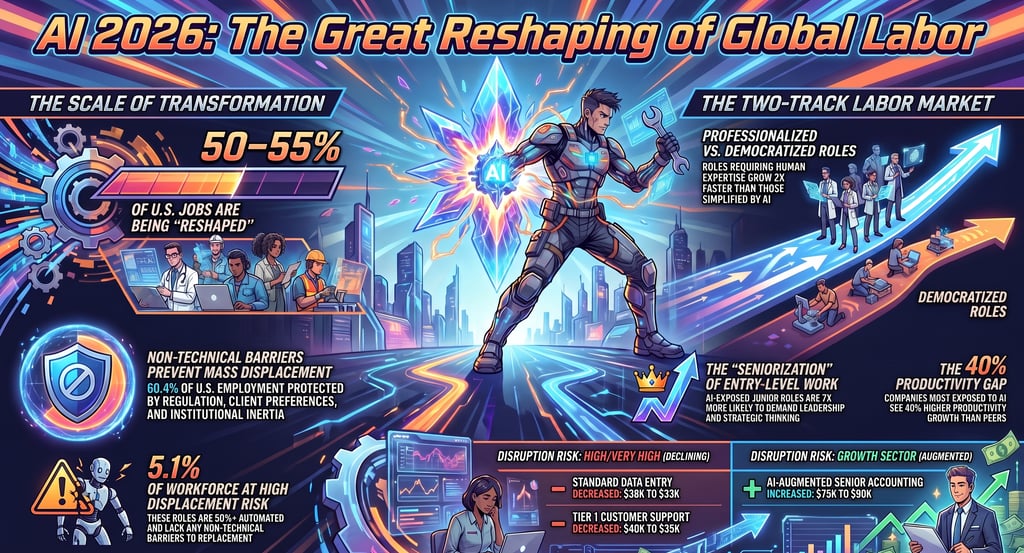
Did you know that over the next two to three years, a staggering 50% to 55% of all jobs in the United States will be fundamentally reshaped by Artificial Intelligence? Even more alarming, an estimated 10% to 15% of roles face total elimination within the next half-decade. We are standing at the precipice of the most profound labor market transformation in modern history.
I am Buzz Leaps, author and publisher of motivational books, and I have dedicated my life to encouraging people to take up future-proof skills so they can become independent and stop relying on fragile corporate jobs. In my recent book, When the Money Runs Out—which recently became an Amazon Kindle bestseller—I talk extensively about the dangers of dependency in a shifting economic landscape. Today, I want to decode the breaking global employment data from mid-2026 and explore how the Artificial Intelligence paradigm is rewriting the rules of wealth, work, and survival.
If you want to protect your livelihood, you must understand the data. Let’s dive deep into the global job market headlines, the reality of AI disruption, and how you can position yourself to win.
Part 1: The Global Job Market in 2026 — A "Slack Water" Phase
Across the globe, traditional employment is faltering. Economists are describing the current labor market as a "slack water" phase—that moment between incoming and outgoing tides when the water barely moves. Companies are hoarding talent but freezing new hires, leading to an environment where breaking into the market is harder than ever.
The United States: A Dramatic Cooling
The U.S. labor market has hit a wall. In June 2026, the U.S. economy added a mere 57,000 jobs, falling massively short of the 110,000 expected by economists. Furthermore, the job numbers for April and May were revised downward by a combined 74,000 positions. The unemployment rate ticked down slightly to 4.2%, but this was driven by people dropping out of the labor force rather than finding new work. The number of long-term unemployed individuals—those jobless for 27 weeks or more—remains stubbornly high at 1.9 million, making up 27.3% of the total unemployed population.
Canada: A Surprise Spike Amidst Structural Issues
In a rare bright spot, Canada's labor market experienced a surprise surge, adding 88,000 jobs in May 2026 and bringing the unemployment rate down to 6.6% from 6.9% in April. These gains were concentrated in construction, transportation, and full-time work. However, the Bank of Canada warns that this volatility masks deeper structural issues. The Canadian workforce is rapidly aging, and youth are bearing the brunt of the hardship. The share of unemployed people who have been looking for work for over six months has reached historic highs not seen since the early 2000s, excluding the pandemic anomaly.
Europe and the United Kingdom: Stagnation and Fragility
In the Eurozone, the unemployment rate held steady at a historic low of 6.2% in May 2026, with the broader European Union sitting at 5.9%. However, the United Kingdom paints a more fragile picture. While the UK unemployment rate eased slightly to 4.9% in the three months to April 2026, job vacancies plummeted to a five-year low of 707,000 as employers pulled back on recruitment due to geopolitical uncertainties and rising costs. Most concerning is the UK's youth unemployment rate, which has surged to a decade-high of 16.2%.
Australia: Part-Time Gains Masking Weakness
Australia’s unemployment rate dropped slightly to 4.4% in May 2026 as the economy added 40,300 jobs. While the headline number looks positive, a deeper look reveals that this was largely driven by a rise of 35,200 part-time jobs. Meanwhile, total monthly hours worked actually fell by 1.1%, and the underemployment rate rose to 5.9%, indicating that Australians are struggling to secure the full-time hours they need to survive in an inflationary environment.
China: State-Driven Stabilization
China’s surveyed urban unemployment rate eased to 5.1% in May 2026, the lowest reading since December 2025. The youth unemployment rate (excluding students) also fell to an 11-month low of 15.6%. The Chinese government is actively trying to stabilize this landscape. In June 2026, the State Council released the "15th Five-Year Plan for Implementing the Employment-First Strategy," placing a massive emphasis on managing their 851 million-strong working population and utilizing new technologies to boost employment while containing societal discontent over wage inequality.
India: Vulnerability to Global Shocks
India’s unemployment rate rose to 5.5% in May 2026, the highest level in nearly a year. This spike was directly aligned with global macroeconomic headwinds, including energy price surges caused by shipping disruptions in the Persian Gulf, which weakened the rupee and crushed purchasing power. India's labor market remains deeply divided. While urban unemployment fell to 6.4%, rural unemployment rose to 5.1%. A profound gender gap also persists: the male labor force participation rate stands at roughly 77.4%, while the female participation rate languishes at a mere 32.8%. Furthermore, youth unemployment in India remains critically high at 15.2%, a symptom of the massive gap between the degrees young people hold and the actual skills the modern market demands.
Part 2: The Artificial Intelligence Paradigm Shift
If the macroeconomic data tells us anything, it is that the old ways of working are dying. The traditional career ladder is compressing, and companies are fundamentally changing how they operate. At the heart of this transformation is Generative Artificial Intelligence.
We are not just talking about chatbots anymore. We are talking about agentic AI—systems that can plan tasks, use digital tools, and complete complex assignments with little or no human oversight.
According to PwC's 2026 Global AI Jobs Barometer, AI is creating a "two-track" labor market. Productivity growth is 40% higher at companies highly exposed to AI compared to those with low exposure. In this two-track market, jobs that are "professionalized" by AI (requiring high human expertise augmented by machine intelligence) are growing twice as fast as roles that are "democratized" by AI, and these professionals are seeing 42% faster wage growth.
The skills needed for jobs most exposed to AI are changing more than twice as fast as other roles. Junior roles are being entirely redefined. Today, an AI-exposed entry-level job is seven times more likely to demand traditionally senior skills, like strategic thinking and leadership, because AI is absorbing the routine, repetitive tasks that junior employees used to cut their teeth on.
Disruption Risk: Which Jobs Are Dying and Which Are Thriving?
A comprehensive mid-2026 structural assessment by the World Economic Forum and various labor analysts highlights this exact divergence. The market is bifurcating into roles that are actively being eliminated and roles that are seeing historic wage premiums.
The Fastest Declining Roles: Data entry clerks, basic bookkeepers, Tier-1 customer service representatives, commodity content writers, and routine administrative roles are facing active elimination. In the customer service sector, major companies are reducing headcount by up to 30-40% because AI can now seamlessly handle 70% of routine interactions. As a result, the salaries for the remaining human roles in these categories are stagnating or actively declining, dropping from averages of $40,000 to $35,000. By 2028, we expect a 65% to 80% reduction in traditional data entry jobs.
The Fastest Growing Roles: Conversely, AI and Machine Learning Specialists, Information Security Analysts, Digital Transformation Specialists, and AI Interaction Designers are seeing an unprecedented boom. If you are an AI-augmented Software Developer, your salary premium is roughly 32% higher than a non-AI-augmented peer ($145,000 vs. $110,000). If you are a Content Strategist orchestrating AI workflows, your premium is 38%.
This is the core premise I write about in When the Money Runs Out. You cannot rely on a corporation to save you when the fundamental economics of your job can be outsourced to an algorithm. You must become the person who controls the algorithm.
The Secret Weapon: N8n AI Agent Development
If you want to become truly independent, you must acquire skills that are scarce, highly valuable, and completely detached from the traditional 9-to-5 grind. One of the most powerful and lucrative skills you can learn today is n8n AI agent development.
n8n is an advanced workflow automation tool that allows you to connect different APIs, databases, and AI models to create fully autonomous agents. By mastering n8n AI agent development, you are no longer just an employee; you become a one-person digital agency. You can build automated systems that handle lead generation, customer support, data analysis, and content distribution for multiple clients simultaneously. Businesses are desperate for professionals who can implement these complex, agentic AI workflows. Learning n8n AI agent development gives you the leverage to dictate your own income, set your own hours, and build a fortress of self-reliance that no economic downturn or corporate layoff can breach.
Part 3: The Deep Mechanics of Job Reshaping
Why is AI destroying some jobs but amplifying others? The Boston Consulting Group (BCG) provides a brilliant microeconomic framework that explains this phenomenon. Task automation does not automatically equal job loss. Instead, it depends on two factors: Substitution vs. Augmentation and Demand Expandability.
When an AI lowers the cost of producing something, does the demand for that product have a ceiling?
Bounded Demand (Substitution): Take a call center. The volume of customer complaints is largely fixed by the size of the customer base. When AI handles 70% of those calls, the company does not suddenly need to process 70% more calls. The demand is bounded. Therefore, AI substitutes the human worker, and jobs are eliminated.
Expandable Demand (Amplification): Now look at software engineering. The demand for new software, digital products, and code is practically infinite. When AI makes a software engineer twice as fast, the company doesn't fire half its engineers; it builds twice as many products. The demand expands. The AI augments the worker, and those jobs thrive.
BCG categorizes the US labor market into distinct segments based on this reality:
Amplified Roles (5%): Humans remain central, demand expands, and wages inflate (e.g., Software Engineers, Senior Legal Advisors).
Rebalanced Roles (14%): Demand is bounded, but roles are redesigned. Routine tasks vanish, but complex responsibilities expand, requiring massive upskilling (e.g., Content Marketers).
Divergent Roles (12%): Entry-level positions are heavily automated, causing job losses at the bottom, while senior positions persist and grow (e.g., IT Support, Insurance Sales).
Substituted Roles (12%): Demand is capped, and AI directly substitutes human core tasks. Efficiency gains translate directly into net job losses (e.g., Routine Financial Analysts, Call Center Reps).
Enabled Roles (23%): AI is embedded into daily tasks (like taking notes for doctors), raising productivity expectations but not fundamentally changing the human-led nature of the work.
If you are stuck in a Substituted or Divergent role, your career is a ticking time bomb. You must pivot toward Amplified or Enabled roles. You must become the orchestrator of the technology.
Part 4: Trust, Environment, and The Global AI Divide
As we navigate this economic shift, we must also be fiercely aware of the broader societal impacts of AI. Technology is advancing much faster than government regulations or ethical guardrails can keep up.
The Erosion of Truth and the Governance Gap
The democratization of AI has made sophisticated audio and video manipulation incredibly cheap and scalable. Deepfakes and AI-generated media are fundamentally eroding institutional trust. As noted by researchers at the LaCross Institute for Ethical Artificial Intelligence, ethics must be embedded as infrastructure, not patched in as an afterthought. From biased hiring algorithms to companion chatbots for toddlers that risk worsening human isolation, the psychological and democratic risks are staggering. We are entering an era where seeing is no longer believing.
The Geopolitical Concentration of Power
The global AI landscape is fiercely asymmetrical. According to the 2026 AI Index Report by Stanford University, the United States leads private AI investment, committing over $285 billion in 2025 alone. The performance gap between the US and China has effectively closed, with models from both nations trading the top spots.
However, the physical infrastructure of AI represents a massive bottleneck and environmental crisis. The United States currently hosts 5,427 AI data centers—more than ten times any other country. The energy required to run these centers is colossal, and the water needed for cooling is straining local resources. Furthermore, the global supply chain is perilously dependent on a single foundry in Taiwan (TSMC) to fabricate almost every leading AI chip.
Despite these risks, the benefits of AI in science and medicine are undeniably miraculous. AI has mapped the structures of over 200 million proteins, accelerated drug discovery, tracked antibiotic resistance, and improved early-stage cancer detection. The technology is not inherently evil; it is a tool of unprecedented leverage. The question is simply who holds the lever.
Part 5: Your Blueprint for Survival
We are no longer in an era where going to college and handing your resume to a corporation guarantees a safe, comfortable life. The 2026 data proves it: total nonfarm payrolls in the US are essentially stagnant. Wages are only growing for those who control the machines.
You have to upskill. If your job relies on repetitive data processing, basic content creation, or routine administration, you are competing against an algorithm that works 24/7, doesn't need health insurance, and gets smarter every single day.
Here is your action plan:
Embrace AI Fluency: You must understand what Large Language Models can and cannot do. Learn the basic terminology and start integrating AI into your daily workflow immediately.
Learn High-Leverage Tech: Do not just be a consumer of AI; be a creator. Look into n8n AI agent development, API integrations, and prompt engineering. These are the modern-day equivalents of learning to read and write during the industrial revolution.
Cultivate Uniquely Human Skills: Empathy, complex strategic judgment, ethical oversight, and physical dexterity cannot be automated yet. Combine your human soft skills with hard AI automation skills to make yourself irreplaceable.
When the Money Runs Out wasn't written to scare you; it was written to wake you up. The jobs report is flat. The youth unemployment in places like the UK and India is soaring. Corporations are looking for process efficiency and employee productivity, and 41% of employers explicitly plan to reduce their workforce due to AI automation.
Do not wait for the tide to go out completely. Build your own boat.
Context Reference & Conclusion
As referenced in the mid-2026 structural context reports, including the Global Labor Dynamics assessment and the UN Independent International Scientific Panel on AI, the window to adapt is rapidly closing. We are navigating a period of high variance, where the transition from human-led routine work to AI-augmented strategic work will dictate the winners and losers of the next decade. The statistics don't lie. 50% to 55% of the workforce is changing right now. The only real security is the value you can independently create. Take charge of your education, learn the tools of tomorrow, and build a life of true independence.
Reference Links / Sources:
11 things AI experts are watching for in 2026 | University of California (https://www.universityofcalifornia.edu/news/11-things-ai-experts-are-watching-2026)
AI Jobs Barometer - PwC (https://www.pwc.com/gx/en/services/ai/ai-jobs-barometer.html)
AI Will Reshape More Jobs Than It Replaces | BCG (https://www.bcg.com/publications/2026/ai-will-reshape-more-jobs-than-it-replaces)
AI explained: Why the world needs to act now | UN News (https://news.un.org/en/story/2026/07/1167848)
Australia Unemployment Rate - Trading Economics (https://tradingeconomics.com/australia/unemployment-rate)
Australian unemployment rate falls to 4.4 pct - Xinhua (https://english.news.cn/asiapacific/20260625/d85f9f91c12d45c68ead8f7a7d152343/c.html)
Automation, AI, and Job Displacement Risk in U.S. Employment (2026) - SHRM (https://www.shrm.org/in/topics-tools/research/automation-generative-ai-and-job-displacement-risk-in-u-s--employment/2026-full-report)
Canada sees surprise jobs hike, unemployment rate drops - Canadian Affairs (https://www.canadianaffairs.news/2026/06/06/canada-sees-surprise-jobs-hike-unemployment-rate-drops/)
Canada's labour market: between cycles and structural change (https://www.bankofcanada.ca/2026/05/canadas-labour-market-between-cycles-structural-change/)
China PMI June 2026 - FocusEconomics (https://www.focus-economics.com/countries/china/news/pmi/china-pmi-30-06-2026-manufacturing-and-non-manufacturing-pmis-rise-in-june/)
China Plans To Stabilize Employment in an Age of Change - Stratfor (https://worldview.stratfor.com/article/china-plans-stabilize-employment-age-change)
China Unemployment Rate - Trading Economics (https://tradingeconomics.com/china/unemployment-rate)
China Youth Unemployment Rate - Trading Economics (https://tradingeconomics.com/china/youth-unemployment-rate)
Decoding the Data: Unemployment Trends India 2026 - A ViewPoint (https://aviewpoint.in/posts/decoding-the-data-unemployment-trends-in-india-2026)
EU jobless rate dips to 5.9% in May - Staffing Industry Analysts (https://www.staffingindustry.com/news/global-daily-news/eu-jobless-rate-dips-to-59-in-may)
Economic Outlook Canada Q3 2026: Resilient, Not Strong - S&P Global (https://www.spglobal.com/ratings/en/regulatory/article/economic-outlook-canada-q3-2026-resilient-not-strong-s101692525)
Economy adds 88,000 jobs as unemployment rate falls to 6.6% - CHAT News Today (https://chatnewstoday.ca/2026/06/05/statistics-canada-set-to-release-jobs-data-for-may-this-morning/)
Employment Situation Summary - 2026 M06 Results - Bureau of Labor Statistics (https://www.bls.gov/news.release/empsit.nr0.htm)
Employment in the UK: June 2026 - Office for National Statistics (https://www.ons.gov.uk/employmentandlabourmarket/peopleinwork/employmentandemployeetypes/bulletins/employmentintheuk/june2026)
Ethics Is the Defining Issue for the Future of AI - Darden Report (https://news.darden.virginia.edu/2026/01/22/ethics-is-the-defining-issue-for-the-future-of-ai-and-time-is-running-short/)
Euro Area Unemployment Rate - Trading Economics (https://tradingeconomics.com/euro-area/unemployment-rate)
Euro area unemployment at 6.2% - Eurostat (https://ec.europa.eu/eurostat/web/products-euro-indicators/w/3-02072026-ap)
Exploring the societal impacts of AI | MIT News (https://news.mit.edu/2026/exploring-societal-impacts-of-ai-0623)
Global Labor Dynamics and the Generative Artificial Intelligence Paradigm: A Mid-2026 Structural Assessment
India Unemployment Rate - Trading Economics (https://tradingeconomics.com/india/unemployment-rate)
India's Unemployment Rate in 2026 - India Macro Indicators (https://indiamacroindicators.co.in/resources/blogs/india-unemployment-rate-in-2026)
June 2026 Jobs Report: An Unmoving Tide - Indeed Hiring Lab (https://www.hiringlab.org/2026/07/02/june-2026-jobs-report-an-unmoving-tide/)
Labour Force, Australia, May 2026 - Australian Bureau of Statistics (https://www.abs.gov.au/statistics/labour/employment-and-unemployment/labour-force-australia/latest-release)
Labour market overview, UK: June 2026 - Office for National Statistics (https://www.ons.gov.uk/employmentandlabourmarket/peopleinwork/employmentandemployeetypes/bulletins/uklabourmarket/june2026)
PERIODIC LABOUR FORCE SURVEY (PLFS) MONTHLY BULLETIN - May, 2026 - PIB (https://www.pib.gov.in/PressReleasePage.aspx?PRID=2272969)
The 2026 AI Index Report | Stanford HAI (https://hai.stanford.edu/ai-index/2026-ai-index-report)
The 2026 AI Job Disruption Report - AI Magicx (https://www.aimagicx.com/blog/ai-job-disruption-report-roles-eliminated-created-2026)
The AI and labor landscape 2026 - S&P Global (https://www.spglobal.com/en/research-insights/special-reports/ai-impact-on-employment-2026)
UK vacancies fall to lowest for five years - The Guardian (https://www.theguardian.com/business/2026/jun/18/uk-unemployment-rate-falls-wages-interest-rates-iran-war)
US economy added jobs at a slower pace than expected in June - Fox Business (https://www.foxbusiness.com/economy/us-jobs-report-june-2026)
Unemployment Rate In India 2026 - PWOnlyIAS (https://pwonlyias.com/unemployment-rate-in-india/)
Unemployment decline, solid spending, heaps pressure on RBA - MacroBusiness (https://www.macrobusiness.com.au/2026/06/unemployment-decline-solid-spending-heaps-pressure-on-rba/)
United Kingdom Unemployment Rate - Trading Economics (https://tradingeconomics.com/united-kingdom/unemployment-rate)