<script async src="https://pagead2.googlesyndication.com/pagead/js/adsbygoogle.js?client=ca-pub-7001450216977829"
crossorigin="anonymous"></script>
Survive the Shocking 2026 AI Job Market Paradox: Thrive Using an n8n Workflow Automation Company
Discover shocking 2026 AI job market trends. Learn to survive the slack water economy, master new skills, and gain independence using an n8n workflow automation company.
7/4/202613 min read
The Great AI Divide: How to Thrive in the 2026 "Slack Water" Economy
Did you know that out of every five people working in knowledge-based jobs today, almost four will see their roles fundamentally changed by AI within the next decade? Or that entry-level job vacancies in highly AI-exposed fields haven't grown since 2012? What’s even more shocking is that companies embracing AI are seeing a massive 163% increase in productivity, while workers with advanced AI skills are commanding a staggering 62% wage premium. The world is changing beneath our feet.
Welcome, independent thinkers and future leaders. I am Buzz Leaps, author and publisher of motivational books dedicated to helping you break free from the traditional corporate grind. My mission is to encourage people to take up future-proof skills so they can become independent and never have to rely on the whims of a traditional job market again. As I discussed in my recent book, When the Money Runs Out—which recently became an Amazon best-seller thanks to readers like you—the days of trading hours for dollars in a secure, lifelong corporate job are over. Today, we are going to dive deep into the latest mid-2026 research on the global job market, how Artificial Intelligence is completely rewriting the rules of the economy, and how you can leverage tools from an n8n workflow automation company to build your own independent income streams.
Grab a cup of coffee, take out your notepad, and let’s dive into the statistics, the trends, and the mindset shifts you need to survive and thrive.
Part 1: The Global Job Market—Welcome to the "Slack Water" Equilibrium
Right now, the global labor market is experiencing what economists are calling a "slack water" equilibrium. If you've ever watched the tide, slack water is that brief, eerie moment between an incoming and outgoing tide where the water hardly moves. Aggregate hiring has cooled down significantly, but massive structural layoffs are not sweeping the globe the way they did during past recessions. Relatively few workers are being pulled into new jobs, and few are being pushed out of old ones.
However, beneath this calm surface, the performance of the job market is highly fragmented depending on where you look:
The United States Hiring in the U.S. cooled sharply in June 2026, with the economy adding only 57,000 jobs—falling well short of the 100,000 to 115,000 jobs that economists had expected. Furthermore, job gains for April and May were revised downward by a combined 74,000 jobs, showing that the momentum was softer than initially thought. The national unemployment rate edged down slightly to 4.2%, its lowest level in a year. However, this dip wasn't entirely good news; it was primarily driven by 720,000 workers exiting the labor force rather than a surge in new employment.
Canada In contrast to the U.S., the Canadian labor market showed incredible resilience. In May 2026, Canada added 88,000 jobs, a 0.4% increase that rebounded from a sluggish start to the year. This growth was driven entirely by full-time employment, which saw an addition of 154,000 roles. This surge brought the Canadian unemployment rate down 0.3 percentage points to 6.6%.
Europe Across the Atlantic, labor markets in the Eurozone remain structurally tight and stable. In May 2026, the Euro area unemployment rate stood at 6.2%, which is stable compared to the previous month and down from 6.3% in May 2025. The broader European Union unemployment rate was 5.9%. However, regional disparities persist. Germany boasts a remarkably low 3.8% unemployment rate, while countries like Spain and Finland recorded the highest rates at 10.3% and 10.6%, respectively.
Australia Australia delivered a stronger-than-expected performance in May 2026, with the unemployment rate falling to 4.4% as the economy added 40,300 jobs. However, digging deeper into the data reveals some underlying weakness: the growth was tilted heavily toward part-time employment, which saw an increase of 35,200 jobs. Meanwhile, total monthly hours worked across all jobs actually decreased by 22 million hours, and the underemployment rate inched up to 5.9%.
China China saw encouraging stabilization, particularly in its youth cohort. The urban youth unemployment rate (ages 16–24, excluding students) fell to an 11-month low of 15.6% in May 2026, recovering from previous peaks. The broader urban unemployment rate also ticked down slightly to 5.1%.
India Faced with macroeconomic headwinds—including supply-chain shocks in the Persian Gulf that weakened the rupee and dampened purchasing power—India's overall unemployment rate rose to an 11-month high of 5.5% in May 2026. This deterioration was driven entirely by rural joblessness, which rose to 5.1%. Conversely, the urban unemployment rate actually improved, falling to a one-year low of 6.4%.
What This Means for You: The traditional job market is stagnating. As I outlined in When the Money Runs Out, relying on a single employer in a "slack water" economy is a tremendous risk. Companies are not hiring at the explosive rates they once were. But as we are about to see, the real disruption isn't coming from economic cycles—it’s coming from Artificial Intelligence.
Part 2: The Two-Track Economy and the AI Wage Premium
Artificial intelligence has evolved from software experimentation into a pervasive macroeconomic force. PwC’s 2026 Global AI Jobs Barometer analyzed over a billion job ads and found that AI is fundamentally reshaping the global economy into a "two-track" labor market.
AI is driving a massive wedge between different types of jobs. It is separating roles into "professionalised" jobs (where AI acts as a force multiplier for experts) and "democratised" jobs (where AI makes tasks so easy that non-experts can perform them).
The rewards for being on the right side of this track are astronomical. Jobs requiring specific AI skills are growing almost eight times faster (69%) than the broader job market (9%). Workers equipped with advanced AI skills are commanding massive wage premiums, averaging 62% higher pay across the globe, and up to 118% higher in specific sectors like consumer markets.
Furthermore, "super-star companies" that successfully integrate AI are pulling away from their competitors. The top 20% of the most AI-exposed companies achieved an average labor productivity growth of 163% relative to 2018. Perhaps surprisingly, these highly AI-exposed organizations are actually seeing faster headcount growth (52%) than the least AI-exposed companies (36%), and they are sharing these gains with workers through 24% higher wage growth.
The Lesson: AI is not a job killer; it is a job expander for those who know how to use it to unlock growth and create new forms of value. This is why I constantly advocate for upskilling. If you can master AI—whether it's using predictive models, generative AI, or partnering with an n8n workflow automation company to streamline your independent business—you place yourself on the fast track. You become the 163% more productive individual. You command the 62% wage premium. You become undeniable.
Part 3: The "Broken Staircase" – What AI Means for Entry-Level Graduates
If you are young, recently graduated, or looking to start a new career path, you are facing a historically unique challenge. A new report by the World Economic Forum (WEF) and PwC details how AI is transforming entry-level work, warning of a "broken staircase".
Historically, entry-level jobs—such as junior analysts, legal clerks, and junior developers—served as informal apprenticeships. Young graduates performed routine information-processing tasks, and through this repetition, they learned institutional norms and developed professional judgment.
Generative AI is highly proficient at these exact routine tasks. Because basic data extraction, drafting, and document summarization can now be executed almost instantaneously by software, entry-level vacancies in the most AI-exposed fields (like finance and tech) have flatlined since 2012. Think about that: while the rest of the economy grew, the jobs with the highest AI exposure simply stopped expanding. More than 1 in 3 young workers worldwide (37%) are currently employed in occupations highly exposed to AI-driven task changes. In Eastern Asia, that figure jumps to an astonishing 75%, while in North America it sits at 69%.
But companies aren't just eliminating these jobs; they are "seniorising" them. The entry-level roles that do exist now require traditionally senior-level skills. Analysis of U.S. data shows that AI-exposed entry-level roles are now seven times more likely to require advanced skills like leadership, strategic judgment, creativity, and complex decision-making. Job openings for these "seniorised" entry-level roles have grown 35% since 2019, while other entry-level roles shrank by 10%.
Because organizations can automate the bottom rungs of the ladder, they expect new hires to act as directors and auditors of AI outputs from day one. If companies aren't careful, they risk severing their own talent pipelines—removing the staircase but expecting the upper levels of their business to remain populated.
Some companies are adapting brilliantly. Dropbox, for example, took the opposite approach. Instead of shrinking its graduate pipeline, it expanded its emerging talent intake by 25%. They look for candidates who can use AI effectively and integrate AI into their internships, essentially using the technology as a "capability multiplier". Their interns and graduate hires now dramatically outperform externally hired peers, with 87% achieving promotions by year three.
The Lesson: Do not wait for a company to train you. The entry-level jobs that used to train you no longer exist in the same way. You must develop your own strategic judgment, leadership, and AI-auditing skills independently.
Part 4: The Great Skill Inversion: What Makes You Valuable Now?
With AI automating routine data processing, what skills should you actually be learning? The International Monetary Fund (IMF) and comprehensive research analyzing the U.S. workforce reveal a fascinating "capability-demand inversion".
AI agents and Large Language Models (LLMs) are incredibly strong at structured, rule-bound reasoning. When tested on the Skill Automation Feasibility Index (SAFI), LLMs scored highest in Mathematics (73.2) and Programming (71.8). However, they scored the lowest on unstructured, deeply human skills: Active Listening (42.2), Reading Comprehension (45.5), Speaking (48.5), and Social Perceptiveness (51.5).
Here is the paradox: The skills that are most demanded in AI-exposed jobs are exactly the skills that AI performs the worst at.
Research mapping tasks to core skills shows a shrinking demand for traditional information-processing skills (like analyzing data and updating knowledge), which used to command high wages. Conversely, there is a massive shift in value toward interpersonal communication, empathy, complex problem-solving, and organizational coordination.
This proves a vital point about the future of work: We are looking at a future of augmentation, not full automation. Data from the Anthropic Economic Index shows that out of all observed AI-task interactions, 78.7% represent augmentation (collaborative interaction where humans iteratively refine AI outputs or learn from AI), while only 21.3% represent pure directive automation (where AI completes a task end-to-end without human iteration).
As the WEF framework suggests, the most successful organizations are adopting a "human first" strategy. This means they are using AI to elevate human potential, relying on human judgment, creativity, and empathy to guide the immense processing power of the machines.
The Lesson: Your humanity is your greatest asset. While you must learn to use AI to process information, your ultimate value lies in your ability to communicate, empathize, build relationships, and lead. Machines can write the code and crunch the spreadsheets, but they cannot look a client in the eye, understand their unsaid fears, and negotiate a complex, emotionally-charged deal.
Part 5: AI Transforming Daily Life, Healthcare, and Education
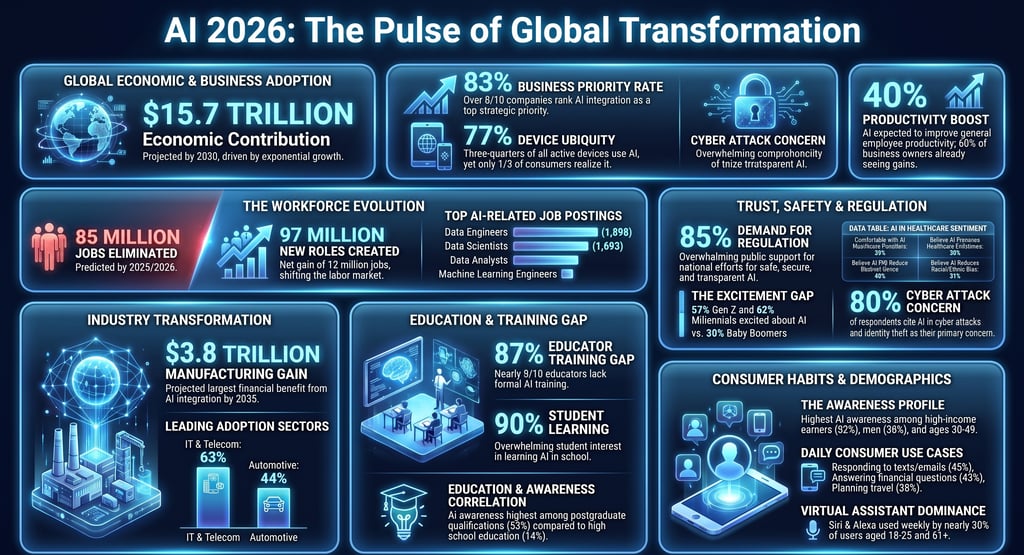
The impact of AI is not confined to corporate offices; it is reshaping the very fabric of our daily lives, infrastructure, and essential services. The 2026 AI Index Report from Stanford HAI notes that organizational adoption of AI has reached 88%, and generative AI reached 53% population adoption within three years—faster than the PC or the internet. The estimated value of generative AI tools to U.S. consumers reached $172 billion annually by early 2026. AI is now an invisible utility, embedded in 77% of active consumer devices.
Let's look at how it is transforming specific sectors:
Healthcare Hospitals are facing severe nursing shortages and cost pressures, leading to a $1.4 billion surge in healthcare AI spending in 2025. Electronic health records now increasingly incorporate "ambient AI scribes". These co-pilots record and summarize patient conversations in real-time, drastically reducing administrative burnout for doctors and freeing them up for face-to-face care. AI clinical assistants synthesize patient data and medical literature to reduce diagnostic errors. However, trust remains a barrier: while 74% of patients report trusting AI-generated answers, 78% expect their doctors to validate this information with a trusted clinical source.
Education Adoption in education is moving at historic speeds. Currently, 80% of university students globally utilize generative AI for their studies. Educators are using AI for lesson material generation and administrative workflow automation, allowing 33% of them to prioritize active instruction. Yet, deep barriers remain here as well, with 80% of parents citing concerns over data privacy, security, and AI-generated "hallucinations".
Daily Life & Infrastructure Beyond personal computing, AI is optimizing our physical world. In transport, AI utilizes computer vision navigation and GPS routing optimization to ease urban traffic and advance autonomous vehicle networks. The most common ways consumers use AI in their personal lives are answering texts or emails (45%), answering financial questions (43%), and making travel plans (38%).
The Lesson: AI is inescapable. It is in our hospitals, our schools, our cars, and our pockets. Those who resist it will be left navigating a world they no longer understand. Embrace these tools to optimize your health, your learning, and your daily efficiency.
Part 6: The "AI Layoff Trap" and the Dangers of Over-Automation
Despite the incredible productivity gains and the augmentation potential of AI, there is a dark side to this transition. Economists have identified a phenomenon known as the "AI Layoff Trap".
Here is the problem: Individual firms reap the full cost-savings of replacing human workers with AI. However, they only bear a tiny fraction of the macroeconomic cost of lost consumer demand. Displaced workers are also consumers. When their lost income is not replaced, each round of layoffs erodes the purchasing power that all firms depend on.
This creates a competitive prisoner's dilemma, or an "automation arms race." Because no single firm can afford to hold back while its rivals cut costs, firms are incentivized to over-automate. In a competitive task-based model, demand externalities trap rational firms into displacing workers well beyond what is collectively optimal. If AI displaces workers faster than the economy can retrain and reabsorb them, it risks eroding the very consumer purchasing power that businesses rely on. At the limit, this becomes self-destructive: firms automate their way to boundless productivity but find themselves with zero demand because no one has the money to buy their products.
Furthermore, research indicates that free entry into the market, wage adjustments, upskilling, and even Universal Basic Income cannot fully eliminate this over-automation excess. Economists suggest that only targeted policy instruments, like a Pigouvian automation tax, can correct this competitive drive to over-automate.
The Lesson: Corporate America is trapped in a race to the bottom of the payroll spreadsheet. They are structurally incentivized to replace you, even if it hurts the overall economy in the long run. You cannot rely on corporations to save your job, and you cannot rely on slow-moving government policies to protect you in time. You must protect yourself.
Part 7: Take Control—Building Independence in the AI Era
This brings me back to the core message of my book, When the Money Runs Out. You cannot rely on a traditional job. The global labor market is in "slack water," entry-level jobs are a broken staircase, and companies are caught in an AI Layoff Trap where they are mathematically incentivized to replace human labor with autonomous systems.
But remember the other side of the coin: AI is a job expander for those who know how to harness it. It is creating a 163% productivity boom for those who adopt it, and a 62% wage premium for those who master it.
You have a choice. You can be the victim of automation, or you can be the master of augmentation.
If you want to become truly independent, you need to acquire skills that allow you to act as a one-person enterprise. You need to leverage AI to do the work of ten people. For example, by learning to use tools from an n8n workflow automation company, you can visually build complex, automated workflows that handle your marketing, customer outreach, data entry, and financial tracking. You can integrate Large Language Models directly into your daily processes, allowing an AI agent to handle the repetitive, structured tasks (where they excel at a SAFI score of 70+).
Then, you take the time you saved and invest it in the skills where human agency is essential (H5 on the Human Agency Scale). You invest in interpersonal communication, empathy, complex problem-solving, and creative strategy. You become the auditor, the director, the visionary.
You don't need a massive corporation to hire you if you can build your own digital infrastructure. You can create your own value. You can navigate the transition from a traditional employee to an independent, AI-augmented entrepreneur.
Conclusion: Contextualizing Our Future
We are living through one of the most profound economic transitions in human history. The "slack water" labor market of mid-2026 is just the surface calm above a massive structural realignment. Artificial Intelligence is not just a tool; it is a fundamental rewiring of how value is created, distributed, and rewarded in our society.
While the headlines focus on the 37% of jobs exposed to AI, or the flatlining of entry-level roles, the real story is about adaptation. It is about the 78.7% of AI use cases that are augmenting human potential. It is about the shift from valuing people as human calculators to valuing them as empathetic, strategic leaders.
Do not let the fear of the AI Layoff Trap paralyze you. Use this knowledge. See the board clearly. Upskill yourself, master the automation tools available to you, and double down on the uniquely human traits that no machine can replicate.
Thank you for reading, and for those who have supported When the Money Runs Out, thank you for making it an Amazon best-seller. Keep learning, stay independent, and leap into the future.
— Buzz Leaps
Reference Links / Sources Used: Bureau of Labor Statistics: Employment Situation News Release - 2026 M06 Results, https://www.bls.gov/news.release/archives/empsit_07022026.htm The Daily — Labour Force Survey, May 2026 - Statistics Canada, https://www150.statcan.gc.ca/n1/daily-quotidien/260605/dq260605a-eng.htm Euro indicators - Eurostat - European Commission, https://ec.europa.eu/eurostat/news/euro-indicators Australia Unemployment Rate - Trading Economics, https://tradingeconomics.com/australia/unemployment-rate China Youth Jobless Rate Falls to 11-Month Low - Trading Economics, https://tradingeconomics.com/china/youth-unemployment-rate/news/560660 India Unemployment Rate Rises More than Expected - Trading Economics, https://tradingeconomics.com/india/unemployment-rate/news/559051 AI reshapes global labour market into two distinct paths, rewarding human skills: PwC 2026 Global AI Jobs Barometer, https://www.pwc.com/gx/en/news-room/press-releases/2026/pwc-2026-ai-jobs-barometer.html June 2026 jobs report: Employers add 57,000 jobs | Robert Half, https://www.roberthalf.com/us/en/insights/research/june-2026-jobs-report-employers-add-57000-jobs Artificial Intelligence and the Future of Entry-Level Work: A Framework for Safeguarding and Reinventing Early Career Pathways - The World Economic Forum, https://www.weforum.org/publications/artificial-intelligence-and-the-future-of-entry-level-work-a-framework-for-safeguarding-and-reinventing-early-career-pathways/ The AI Skills Shift: Mapping Skill Obsolescence, Emergence, and Transition Pathways in the LLM Era - arXiv, https://arxiv.org/html/2604.06906v1 How AI Agents and Tech Will Transform Health Care in 2026 - Boston Consulting Group, https://www.bcg.com/publications/2026/how-ai-agents-will-transform-health-care The 2026 AI Index Report | Stanford HAI, https://hai.stanford.edu/ai-index/2026-ai-index-report The AI Layoff Trap - arXiv, https://arxiv.org/html/2603.20617v1 137 AI Statistics and Trends for 2026 | National University, https://www.nu.edu/blog/ai-statistics-trends/ The Global Labor Equilibrium and the Multi-Dimensional Integration of Artificial Intelligence: Mid-2026 Analytical Synthesis (Internal Markdown Synthesis)