<script async src="https://pagead2.googlesyndication.com/pagead/js/adsbygoogle.js?client=ca-pub-7001450216977829"
crossorigin="anonymous"></script>
Survive the Seismic AI Job Crisis: Master Custom n8n Automation Services for Ultimate Independenc
The global job market is fracturing. Discover the shocking statistics behind AI labor displacement and learn how offering custom n8n automation services can secure your ultimate financial freedom today.
CUSTOM N8N AUTOMATION SERVICES,GLOBAL EMPLOYMENT TRENDS 2026, AI JOB IMPACT, TECH LAYOFFS 2026, FUTURE OF WORK, JOB MARKET TRENDS WORLDWIDE, AI REPLACING JOBS, HIRING SLOWDOWN 2026, EMPLOYMENT CRISIS GLOBAL, WORKFORCE TRANSFORMATION, JOBS AND AI
7/6/20269 min read
The Great Global Job Shift: Why You Must Become Independent in the AI Era
Did you know that while artificial intelligence was cited as the leading cause for 31% of all U.S. job cuts in June 2026, the companies spending the absolute most on AI are actually hiring faster than everyone else? Or consider this: India’s actual employment rate has collapsed from 42.7% a decade ago to just 38.7% today, meaning millions are simply vanishing from the workforce entirely.
Welcome to the new reality. I am Buzz Leaps, author and publisher of motivational books, and my mission is to encourage people to take up skills that guarantee true independence so you never have to rely on a traditional job again. In my recent Amazon Kindle bestseller, When the Money Runs Out, I warned about these exact systemic fractures. The data is now in, and the traditional 9-to-5 job market is undergoing a seismic, point-of-no-return transformation.
If you want to survive the macroeconomic shifts and the generative AI revolution, you must understand the landscape. Let’s dive deep into the research on the global employment market and how AI is rapidly reshaping the world around us.
Part 1: The Global Job Market is a Sinking Ship
We are currently witnessing a profound structural divergence in global labor markets. While advanced Western nations are experiencing cyclical cooling, major Asian economies are navigating intense structural friction. The days of relying on a corporation to provide a stable, lifelong career are over. Let's look at the numbers from mid-2026.
The United States: A Cooling Engine The U.S. labor market is showing undeniable signs of exhaustion. In June 2026, the U.S. economy added a mere 57,000 nonfarm payroll jobs—roughly half of what the market expected. While the headline unemployment rate fell slightly to 4.2%, this is a deeply deceptive statistic. This decline was not driven by robust, healthy hiring; rather, it was driven by people completely leaving the labor force.
The labor force participation rate dropped by 0.3 percentage points to 61.5%. The number of long-term unemployed individuals (those jobless for 27 weeks or more) remains stubbornly high at 1.9 million, accounting for 27.3% of all unemployed people. Furthermore, the technology and finance sectors—once the bedrock of high-paying American careers—are hemorrhaging an average of 28,000 jobs per month. The writing is on the wall: the corporate ladder is missing its bottom rungs.
Canada: A Brief Sigh of Relief Amidst Structural Change Canada’s job market saw a rebound in May 2026, adding 88,000 jobs and dropping the national unemployment rate to 6.6% from a peak of 6.9% in April. This included a boost in youth employment. However, this cyclical fluctuation masks the broader structural vulnerabilities shared with its southern neighbor, particularly as automation and shifting trade dynamics continue to loom over the North American continent.
Europe: Resilience Masking Stagnation Across the Atlantic, the Euro Area appears resilient on the surface. The May 2026 unemployment rate tied its record low of 6.2%, while the broader European Union held steady at 5.9%. Yet, Europe is grappling with the same demographic declines and technological disruptions as the rest of the West. A low unemployment rate in a stagnant, aging economy is not a sign of dynamic growth; it is a sign of a shrinking labor pool.
Australia: Softening Demand Australia added 40,300 jobs in May 2026, bringing its unemployment rate down to 4.4%. However, a critical indicator—total hours worked—declined by 1.1%, suggesting a subtle but real softening in labor demand as past interest rate hikes continue to cool the broader economy. Employers are holding onto workers but giving them fewer hours, a classic precursor to a slowing job market.
China: The Youth Employment Crisis In Asia, the narrative shifts from cyclical cooling to structural friction. China’s urban unemployment rate fell to a five-month low of 5.1% in May 2026, and youth unemployment (ages 16–24) dropped to an 11-month low of 15.6%. But do not let the slight dip fool you. Early-career workers in China face a brutally competitive environment as a record 12.7 million fresh graduates flood the market this summer. The domestic "involution" (intense, exhaustive competition) is forcing Chinese firms to cut margins, making it incredibly difficult for young people to secure meaningful, well-paying employment.
India: The Decade of "Jobless Growth" Perhaps the most alarming data comes from India, where the unemployment rate rose to a near one-year high of 5.5% in May 2026. This spike was driven by rural job losses, high energy prices, and a weakened rupee. But the real story in India is the Employment Rate (ER)—the share of the working-age population that actually holds a job. According to the Centre for Monitoring Indian Economy (CMIE), India's ER has plummeted from 42.7% in 2016-17 to just 38.7% by early 2026. This means millions of Indians are suffering from "jobless growth," where the economy expands but fails to create enough jobs to absorb the booming population.
Part 2: The Artificial Intelligence Tsunami
We cannot discuss the global job market without addressing the elephant in the room: Artificial Intelligence. AI has officially transitioned from an experimental novelty into an active driver of global corporate restructuring.
The Great Bifurcation: AI is Not Just a Job Killer For the fourth consecutive month, AI was the leading reason for U.S. job cuts in June 2026. It accounted for 14,029 layoffs, roughly 31% of all job cuts that month. Companies are actively restructuring around AI, automating roles, and reallocating budgets. However, the reality is far more nuanced than a simple "robot apocalypse."
According to the 2026 Global AI Jobs Barometer by PwC, AI is creating a "two-track" labor market. AI is democratizing standard, routine administrative tasks (making them cheaper and requiring fewer humans), while professionalizing jobs that require high-level human expertise, empathy, and complex judgment. Jobs professionalized by AI are growing twice as fast as democratized ones, and they command a 42% higher wage growth.
Paradoxically, the companies spending the most on AI are actually hiring faster than their peers. But they are hiring differently. They want workers who are already highly proficient with AI.
The "Seniorisation" of the Entry Level If you are a young worker relying on a traditional career ladder, pay attention: the bottom rungs are being sawed off. Young workers (ages 22–25) in AI-exposed roles have seen a 16% relative employment decline. Companies are quietly choosing not to backfill entry-level positions when they become vacant.
Because AI is absorbing rote tasks, entry-level jobs are experiencing "seniorisation." AI-exposed junior roles are now seven times more likely to demand traditionally senior skills, such as leadership, strategic thinking, and complex decision-making. You can no longer rely on a corporation to train you from the ground up. You must enter the market already possessing advanced, independent skills.
Part 3: How AI is Transforming the World Around Us
AI is not just changing the job market; it is fundamentally altering the critical infrastructure of human society.
Healthcare: Curing Burnout and Discovering Drugs In healthcare, AI is shifting from a novelty to core clinical infrastructure. "Ambient AI scribes" are now widely used in doctors' offices to record and summarize patient consultations automatically. This technology has reduced clinical documentation time by about 30%, giving physicians more time for patient care and alleviating massive industry-wide burnout.
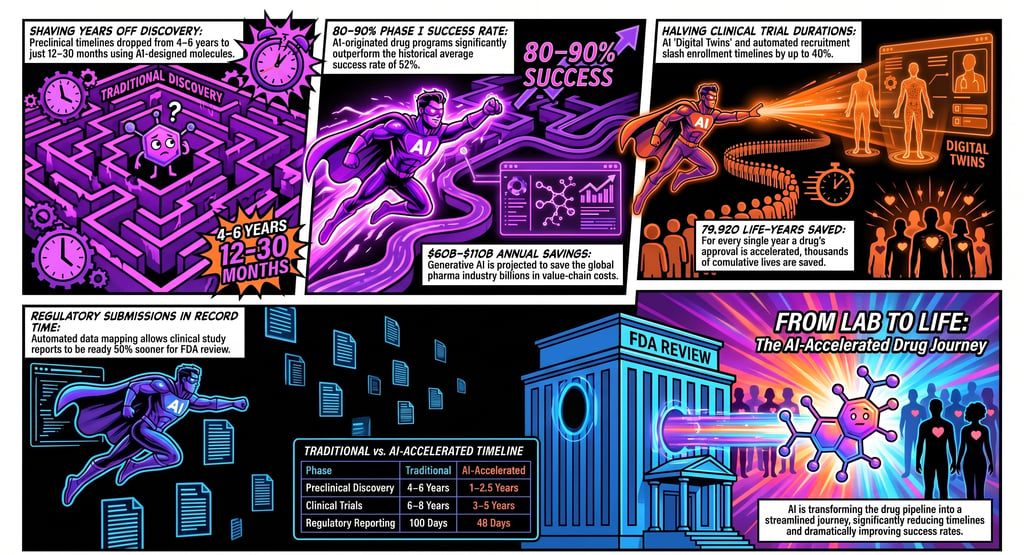
Simultaneously, the AI drug discovery market is exploding. As of 2026, there are over 173 AI-originated drug programs currently in clinical trials. AI platforms are accelerating preclinical testing, optimizing clinical trial design, and predicting patient outcomes, drastically cutting the time it takes to bring life-saving pharmaceuticals to the market.
Education: The End of the "Average Student" The traditional, passive classroom is dying. In 2026, AI is dismantling the "average student" teaching model by driving a shift toward hyper-personalized learning. AI tutors monitor a student's interaction patterns—how long they pause on a sentence or where they make coding errors—and dynamically adjust the cognitive load in real-time to keep them engaged.
Furthermore, generative AI is ending administrative burnout for educators. Tools can now generate complete interactive STEM courses, complete with code editors and adaptive assessments, from a single prompt. Major institutions like Stanford are using AI to generate unique, project-based assessments for every single student, eliminating plagiarism and boosting engagement by up to 40%.
Part 4: The Hidden Bottlenecks—Geopolitics and Energy
If AI is the new engine of the world, it is currently hitting two massive physical and geopolitical ceilings.
The US-China AI Race The geopolitical balance of power in 2026 is increasingly defined by AI dominance. The performance gap between top-tier American and Chinese AI models has effectively closed, narrowing to just 2.7%. The recent release of China’s DeepSeek V4 model—a massive 1.6 trillion parameter open-weight model—achieved performance parity with Western models at a fraction of the cost.
This has reset the global AI race. Organizations like Anthropic have warned that without strategic adaptations and chip controls, China could definitively surpass the U.S. in AI capabilities by 2028. The availability of incredibly cheap, highly capable Chinese open-source models threatens the premium-pricing business models of Western tech giants, democratizing advanced AI across the globe.
The Energy Crisis The exponential growth of AI has collided with a physical reality: the electrical grid. The immense power required to run AI data centers is putting unprecedented strain on public electrical infrastructure.
This operational bottleneck is forcing the tech industry to pivot away from relying solely on public grids. We are seeing a massive wave of private investments in dedicated, on-site clean energy generation to power these AI factories. This includes the revival of dormant nuclear power plants, such as the Palisades plant and the Duane Arnold Energy Center, driven by hyperscalers desperate for stable, carbon-free baseload power. The future of AI is intrinsically tied to the future of global energy production.
Part 5: How to Survive, Thrive, and Become Independent
I didn't write When the Money Runs Out to spread fear. I wrote it to wake you up. The data from the Bureau of Labor Statistics, Statistics Canada, and the Centre for Monitoring Indian Economy all point to the same conclusion: relying on an employer to secure your financial future is the riskiest bet you can make in 2026.
As AI automates the middle class and seniorizes entry-level jobs, you have two choices: become a victim of structural unemployment, or become an independent operator who leverages these exact tools to build your own wealth.
If millions of administrative, coding, and customer service roles are being replaced by AI, you should not be competing for those jobs. You should be the one building and managing the AI systems that replace them.
The Power of Custom Automation To truly free yourself from the crumbling job market, you need to acquire highly leveraged technical skills. One of the most lucrative paths in 2026 is mastering workflow automation.
Every small, medium, and large business is desperately trying to figure out how to integrate AI to save costs, but they don't know how. This is where you step in. By learning to provide custom n8n automation services, you can build a highly profitable independent consulting business. n8n is a powerful, fair-code workflow automation tool that allows you to connect APIs, databases, and AI models (like OpenAI, Claude, or DeepSeek) to automate complex business processes.
Instead of fighting 1,000 other applicants for a single corporate job, you can use custom n8n automation services to help local businesses automate their lead generation, customer support, and data entry. You can build AI-enhanced bookkeeping agencies, automated content creation workflows, or legal document review services. The transition pathways are clear: workers displaced from traditional roles who learn to audit AI outputs, manage agentic workflows, and build automation pipelines are seeing massive salary uplifts.
You do not need a computer science degree to start. You need the motivation to learn, adapt, and build.
Conclusion: Your Context in the New World
The headlines from 2026 paint a stark picture: 57,000 sluggish jobs added in the U.S., India's employment rate sinking to 38.7%, and AI driving massive corporate layoffs. But hidden within this data is the greatest opportunity for wealth generation in a century.
When the Money Runs Out is not just a title; it is a prophecy for the unprepared. The traditional corporate paycheck is drying up. But for those who embrace specialized skills, master AI tools, and offer high-value solutions like custom n8n automation services, the money is just beginning to flow.
Do not wait for the government or a corporation to save you. Take control of your education, leverage the machines before they leverage you, and build your own independent empire today.
— Buzz Leaps Author of the Amazon Kindle Bestseller 'When the Money Runs Out'
Reference Links (For Authenticity and Further Reading)
To ensure the utmost authenticity of the data and insights presented in this blog, please refer to the primary research sources below:
AI Applications in the Drug Development Pipeline | IntuitionLabs
AI Data Center Power: Grid Limits Reshape Energy in 2026 - Enki AI
AI Job Displacement Tracker — 2026 Layoffs & Risk Data - Tech Jacks Solutions
AI in Higher Education Global Survey 2026 Digital Transformation
AI's Impact: Tech and Finance Sectors Losing 28,000 Jobs Monthly - Claims Journal
Anthropic Shares Urgent Warning on US China AI Race by 2028 : r/aicuriosity - Reddit
Bipartisan bill fails to protect US consumers from datacenters' true costs, critics warn
Canada's labour market: between cycles and structural change
China Youth Jobless Rate Falls to 11-Month Low - Trading Economics
China's Youth Unemployment Hits New High As Fresh Graduates Flood Market
Companies spending most on AI are hiring faster than everyone else - HRD America
DeepSeek V4 Signals a New Phase in the U.S.-China AI Rivalry
Employment Situation News Release - 2026 M06 Results - Bureau of Labor Statistics
Flash Report: Unemployment Falls, Job Growth Slows in June - Federal Reserve Bank of St. Louis
From Energy Use to Air Quality, the Many Ways Data Centers Affect US Communities
Graphs, Data and Perspectives: Anatomy of India's (un)Employment over the past decade | DigitalOcean
How AI Agents and Tech Will Transform Health Care in 2026 - Boston Consulting Group
How AI Is Transforming Education in 2026: Beyond the Hype to Real Impact - TutorFlow
Technical Performance | The 2026 AI Index Report | Stanford HAI
Top 20+ Predictions from Experts on AI Job Loss - AIMultiple