<script async src="https://pagead2.googlesyndication.com/pagead/js/adsbygoogle.js?client=ca-pub-7001450216977829"
crossorigin="anonymous"></script>
Survive the 2026 Job Crisis: How to Build an AI Automation Workflow Without Coding
Entry-level jobs are vanishing due to Agentic AI. Protect your career and achieve independence by learning how to build an AI automation workflow without coding.
HOW TO BUILD AN AI AUTOMATION WORKFLOW WITHOUT CODING,AI TOOLS, AI AGENTS, AI AUTOMOTION, AI TRENDSGLOBAL EMPLOYMENT TRENDS 2026, AI JOB IMPACT, TECH LAYOFFS 2026, FUTURE OF WORK, JOB MARKET TRENDS WORLDWIDE, AI REPLACING JOBS, HIRING SLOWDOWN 2026, EMPLOYMENT CRISIS GLOBAL, WORKFORCE TRANSFORMATION, JOBS AND AI
5/25/20269 min read
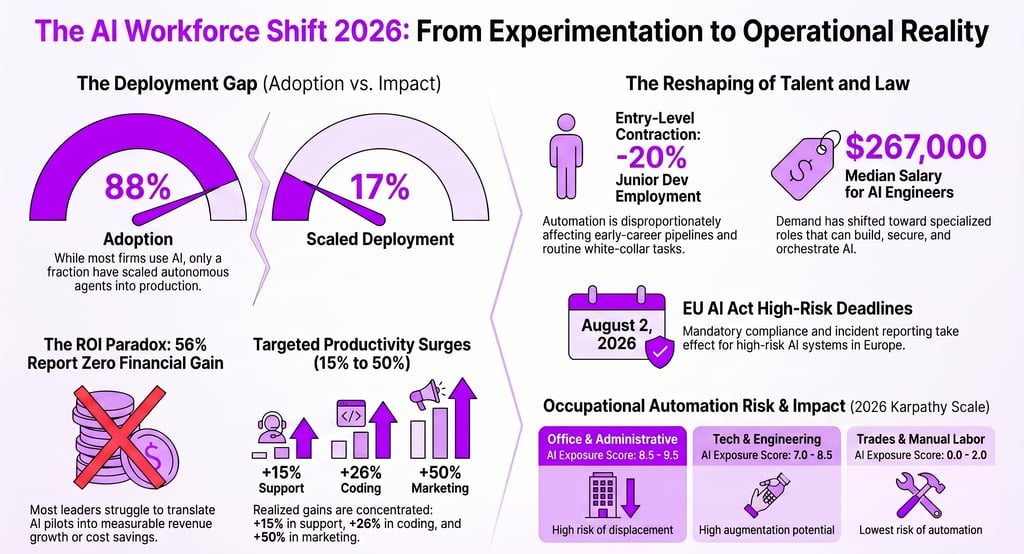
Right now, a terrifying 408 million people worldwide want a job but cannot access one. Even more chilling: in just the last two years, employment for young software developers aged 22 to 25 has inexplicably plummeted by nearly 20%. There is a silent, rapidly accelerating force hollowing out the junior workforce and fundamentally rewriting the global economy while executives stay incredibly quiet about the real reason behind it. What exactly is this invisible mechanism quietly vaporizing entry-level knowledge work across the globe? I will reveal the answer to this suspense—and how it directly dictates your survival—at the end of this post.
I am Buzz Leaps, author and publisher of motivational books dedicated to empowering you to break free from the fragile corporate machine. My mission is to encourage you to take up resilient, independent skills. Relying on a traditional job is no longer safe. Your livelihood can be wiped out overnight by artificial intelligence, geopolitical wars, sudden government regulations, sweeping company policies, or the chaotic global situations we are all experiencing today. You must become independent. And today, we are diving deep into the massive, tectonic shifts happening in the 2026 labor market to understand exactly why you need to take control of your destiny right now.
The Illusion of Macroeconomic Stability If you look at the surface-level economic headlines, you might be lulled into a false sense of security. Global unemployment sits at a projected 4.9% for 2026, pointing to continued resilience following the post-pandemic recovery. In the United States, the seasonally adjusted unemployment rate held perfectly steady at 4.3% in April 2026, with the economy adding 115,000 nonfarm payroll jobs.
However, this stability is an absolute mirage. Beneath the surface, the progress in job quality has completely stalled. Nearly 300 million workers continue to live in extreme working poverty, and 2.1 billion workers remain in informal employment, completely lacking access to basic rights, social protection, or income security. The global jobs gap—capturing people who want paid work but cannot access it—stands at a staggering 408 million.
The hiring that is occurring is highly concentrated. Job growth is primarily driven by physical, hands-on sectors like healthcare, social assistance, transportation, and retail. Meanwhile, the white-collar knowledge economy is bleeding. The U.S. information sector shed 13,000 jobs in April 2026 alone, marking an 11.0% contraction since its peak in November 2022, while federal government employment fell by 9,000 jobs. The traditional desk job is no longer a safe haven; it is a sinking ship disguised as a luxury liner.
The Agentic AI Watershed: The End of the Entry-Level Knowledge Worker The defining technological shift of 2026 is the transition from static, generative chatbots to autonomous "Agentic AI". Triggered by the release of the open-source agent framework OpenClaw in January 2026, AI systems can now autonomously plan, execute, and iterate across complex, multi-step tasks with minimal human intervention.
This is actively disrupting the workforce. Research from Boston Consulting Group indicates that over the next two to three years, 50% to 55% of jobs in the US will be reshaped by AI, while 10% to 15% of jobs could be entirely eliminated over the next five years. Andrej Karpathy, a renowned AI researcher, published a dataset scoring 342 US occupations on an AI-exposure scale of 0-10. He found that office and administrative roles average a high 8/10 exposure, regardless of pay or rank. Furthermore, approximately 42% of US workers are in occupations scoring 7 or higher, representing roughly 59.9 million jobs and $3.7 trillion in annual wages.
Consider the Sales Development Representative (SDR). The AI SDR market has expanded to $5.81 billion in 2026, growing at a compound annual rate of over 32%. Companies are deploying autonomous AI agents directly into lead scoring, prospecting, and live revenue conversations, bypassing human assistance. Industry forecasts indicate that 60% to 70% of current SDR job functions are highly vulnerable to automation within the next 12 to 24 months.
This is creating a "white-collar bloodbath" for junior talent. Over 40% of global CEOs plan to reduce junior-level roles over the next one to two years. Entry into the workforce is becoming increasingly difficult as CEOs rely heavily on experienced mid- and senior-level employees to drive productivity with AI. A Harvard University study showed that firms adopting generative AI have significantly reduced junior-level positions while keeping senior employment largely stable.
The Psychological Toll: The Rise of FOBO and Technostress It is no wonder that the modern workforce is terrified. We are seeing the rapid rise of "FOBO"—the Fear Of Becoming Obsolete. As AI moves beyond simple automation and begins augmenting complex, creative, and strategic work, employees are questioning the future relevance of their jobs.
In Canada, a 2026 survey revealed that 46% of employed Canadians feel AI has impacted their long-term career plans. This impact is incredibly pronounced among university-educated workers, with 59% feeling the pressure compared to just 32% of high school graduates. Young people are caught in the crossfire globally, with youth unemployment standing at 12.4%, and 20% of the world's youth—around 260 million people—not in employment, education, or training.
Even those who have jobs are facing deteriorating mental health. Remote work, once hailed as the ultimate flexibility, is fueling a loneliness epidemic that is forcing a re-evaluation of modern employment. Workers are stressed, isolated, and constantly looking over their shoulders at digital agents that can work 24/7 without a paycheck.
Global Geopolitics, Regulation, and Shifting Borders No government or company is immune to this shift, and relying on bureaucratic protection is a fool's errand. The rapid expansion of agentic AI has prompted divergent regulatory responses worldwide, proving that you cannot wait for lawmakers to save your job.
In the European Union, policymakers are scrambling. Negotiators recently reached a provisional agreement on the "Digital Omnibus on AI," significantly delaying compliance obligations for certain high-risk AI systems because the original rules were too difficult to operationalize. High-risk use cases, like automated hiring platforms, saw their compliance postponed to December 2027, while product-integrated AI obligations were pushed to August 2028. The EU is simultaneously pushing a "Tech Sovereignty Package" to reduce reliance on foreign technology, highlighting the geopolitical tension underlying AI development. The EU AI Act also introduced strict new prohibitions on the use of AI to generate non-consensual intimate material and child sexual abuse material (CSAM), establishing clear boundaries on AI misuse.
In the United States, the regulatory environment is a fragmented battlefield. Lacking a comprehensive federal AI law, individual states have enacted their own rules, leading to active federal court litigation over interstate commerce burdens.
Australia, conversely, has adopted a voluntary approach focused on self-assessment, establishing an AI Safety Institute with a $30 million budget to focus on capability building rather than strict legislative enforcement.
Meanwhile, China and India are taking aggressive, state-guided approaches. China is treating AI as a catalyst for structural job transformation, integrating "AI Job Search Consultants" into its public labor infrastructure under the 15th Five-Year Plan to help over 718,000 college graduates secure preliminary employment. India, hosting the 2026 AI Impact Summit, is pivoting its entire strategy toward "absorption capacity"—the ability to integrate and deploy AI at scale across its young workforce and massive Global Capability Centers (GCCs). The Indian workforce is leading global adoption, with 88% of employees actively utilizing generative AI.
With massive global entities constantly shifting the rules, rewriting trade laws, and battling for digital sovereignty, you are nothing but a pawn if you rely on traditional corporate employment.
The Physical Boom vs. The Digital Bust While the digital knowledge economy shrinks, an unexpected boom is occurring in the physical world. The artificial intelligence revolution is driving a massive physical infrastructure and energy boom. Goldman Sachs estimates that the US will need to fill 500,000 net new jobs in power and electrical infrastructure by 2030 just to sustain the energy and data center demands of AI. Since 2022, U.S. construction jobs tied to data center development—including HVAC contractors and electrical lineworkers—have increased by 216,000. Global AI data center power capacity reached 29.6 GW in 2025, equivalent to the annual electricity consumption of entire nations like Switzerland or Austria.
However, unless you plan on putting on a hard hat and becoming an electrical contractor, you must adapt your digital skill set to survive the white-collar culling.
Taking Control: The Skills You Need to Survive This brings us to the ultimate solution. You cannot rely on an employer. You must become self-sufficient and independent. The most valuable, future-proof skill you can master today is learning how to build an AI automation workflow without coding.
You do not need to be a traditional software developer to thrive in this new economy. In fact, as we already saw, junior software engineering roles are rapidly being eliminated by the very AI they helped create. The people making the real money today are not the ones writing code from scratch; they are the "Agentic AI Platform Engineers" and orchestrators.
By mastering how to build an AI automation workflow without coding, you position yourself above the AI, acting as the architect who directs the digital workforce. Enterprises are desperately hiring professionals who understand orchestration, vector search, and Retrieval-Augmented Generation (RAG). There is massive demand for individuals who can build agents that automate finance, accounting, tax, and audit pipelines.
You can use these exact same orchestration skills to build your own independent micro-businesses. When you know how to build an AI automation workflow without coding, you can automate your own lead generation, run your own autonomous customer support, and deploy your own data research agents. You bypass the fragile corporate ladder by owning the systems that do the work for you. You become immune to company downsizing because you are the one generating pure, automated output.
The Suspense Reveal: The True Cause of the Junior Wipeout At the beginning of this post, I presented you with a horrifying reality: 408 million people trapped in a global jobs gap, and a 20% wipeout of young software developers in just two years. I promised to reveal the invisible mechanism driving this destruction.
It is not just that AI is magically perfect at replacing humans. In fact, the truth is far more embarrassing for the corporate elite.
This crisis is being driven by a macroeconomic paradox known as the "Weakest Link Constraint" and the "GenAI Divide". Despite pouring hundreds of billions of dollars into AI, a staggering 56% of global enterprise CEOs report that AI has yielded absolutely zero revenue growth or cost savings to date. MIT research reveals a shocking 95% pilot-to-production failure rate for AI projects, and Gartner projects that over 40% of all agentic AI transformation initiatives will be cancelled before 2027 due to unclear ROI and escalating costs.
Why is AI failing to deliver on corporate balance sheets? Because organizations are lazy. They are deploying AI as mere "drop-in features" into old, legacy workflows. If a business process requires ten sequential steps, automating nine of them instantaneously yields no actual efficiency if the final step remains bottlenecked by manual human validation or fragmented corporate data.
To compensate for this massive, multi-billion-dollar failure in organizational design, panicked executives are blindly slashing entry-level jobs. They are desperately trying to artificially manifest the cost savings they promised their shareholders, passing the burden onto senior staff who are now forced to supervise flawed, fragmented AI systems. The hollowing out of the junior workforce isn't happening because AI is perfectly replacing them; it is happening because companies are failing to integrate AI correctly, and they are making the most vulnerable workers pay the price!
Your Path to Independence The only way to escape this corporate incompetence is to step entirely outside of it. Do not be the junior worker waiting to be cut to satisfy a CEO's failed AI budget. Be the independent visionary who understands how to orchestrate complete, redesigned autonomous systems.
Take your skills, take your independence, and leap into your own future. Do not rely on governments, do not rely on corporate policies, and do not rely on the outdated illusion of the safe 9-to-5. Master the automation, build your own workflows, and secure your freedom.
--------------------------------------------------------------------------------
Authentic Research Reference Links & Citations:
International Labour Organization (ILO): Employment and Social Trends 2026 - https://www.ilo.org/publications/flagship-reports/employment-and-social-trends-2026
Boston Consulting Group (BCG): AI Will Reshape More Jobs Than It Replaces - https://www.bcg.com/publications/2026/ai-will-reshape-more-jobs-than-it-replaces
Global Policy Watch / Covington: EU AI Act Update: Timeline Relief, Targeted Simplification, and New Prohibitions - https://www.globalpolicywatch.com/2026/05/eu-ai-act-update-timeline-relief-targeted-simplification-and-new-prohibitions/
SoftwareSeni: How Australia's AI Regulation Compares to the EU AI Act, US Approach, and Other International Frameworks - https://www.softwareseni.com/how-australias-ai-regulation-compares-to-the-eu-ai-act-us-approach-and-other-international-frameworks/
CyberPeace: China's New AI and Employment Policy - Innovation and Workforce Well-Being - https://cyberpeace.org/resources/blogs/chinas-new-ai-and-employment-policy---innovation-and-workforce-well-being
International Institute for Strategic Studies (IISS): From safety to impact: what India's AI summit signals about global governance - https://www.iiss.org/online-analysis/online-analysis/2026/02/from-safety-to-impact-what-indias-ai-summit-signals-about-global-governance/
EY: India AI Impact Summit 2026 - https://www.ey.com/en_in/services/ai/india-ai-impact-summit-2026
Goldman Sachs: How Will AI Affect the US Labor Market? - https://www.goldmansachs.com/insights/articles/how-will-ai-affect-the-us-labor-market
DEV Community: Where AI Agent Hiring Is Actually Heating Up: 10 Thread Jobs With Real Market Pull in May 2026 - https://dev.to/marysa_jaramillo_c0344161/where-ai-agent-hiring-is-actually-heating-up-10-thread-jobs-with-real-market-pull-in-may-2026-3m1d
TheStreet: This AI shift is starting to replace a key business function - https://www.thestreet.com/technology/this-ai-shift-is-starting-to-replace-a-key-business-function
Digital Applied: State of AI Agents 2026: 200+ Data Points Compiled - https://www.digitalapplied.com/blog/state-of-ai-agents-2026-200-data-points
Hays: Workforce trends for 2026 - https://www.hays.com.au/blog/insights/workforce-trends
HRD Canada: Half of young Canadians say AI impacting long-term career plans - https://www.hcamag.com/ca/specialization/transformation/half-of-young-canadians-say-ai-impacting-long-term-career-plans-survey/576307
ResumeHog: Late May 2026 Job Market News: Steady Unemployment and Shifting Power Dynamics - https://resumehog.com/blog/posts/late-may-2026-job-market-news-steady-unemployment-and-shifting-power-dynamics.html
AIMultiple: Top 20+ Predictions from Experts on AI Job Loss - https://aimultiple.com/ai-job-loss
Clifford Chance: Artificial Intelligence in 2026: our top ten trends to watch - https://www.cliffordchance.com/insights/thought_leadership/trends/2026/artificial-intelligence-in-2026--our-top-ten-trends-to-watch.html