<script async src="https://pagead2.googlesyndication.com/pagead/js/adsbygoogle.js?client=ca-pub-7001450216977829"
crossorigin="anonymous"></script>
AI Workflow Automation vs Traditional Automation: The Transition to Agentic AI
Discover the key differences in AI workflow automation vs traditional automation. Learn how autonomous AI agents are moving beyond rigid, rule-based systems to reshape enterprise workflows and transform the modern workforce.
HOW TO USE ZAPIER WITH AI AGENTS, AI WORKFLOW AUTOMATION VS TRADITIONAL AUTOMATION, CAN AI AUTOMATE CUSTOMER SUPPORT EMAILS,AI TOOLS, AI AGENTS, AI AUTOMOTION, AI TRENDSMULTI-AGENT AI SYSTEM (MAS), HOW TO AUTOMATE REPETITIVE TASKS WITH AI, AI AUTOMATION FOR SMALL BUSINESS OWNERS, WHAT IS AGENTIC AI AUTOMATION EXPLAINED,
5/10/202610 min read
AI Workflow Automation vs Traditional Automation
I. Introduction to the Automation Evolution
The historical context of workplace automation and the recent inflection point driven by Generative AI and Large Language Models.
The core distinction: AI workflow automation vs traditional automation represents a massive shift from basic assistive tools to autonomous "Agentic AI".
II. The Mechanics of Traditional Automation
Relies entirely on highly structured, repeatable processes with strictly defined inputs and outputs.
Operates using rigid, rule-based logic that is grounded in established precedents and documentation.
Primarily displaces routine, execution-focused tasks but cannot handle ambiguity or open-ended reasoning.
III. The Power of AI Workflow Automation (Agentic AI)
Unlike traditional chatbots that simply respond to prompts, AI agents operate as digital teammates that can plan, act, and adapt independently.
Agents can take on broader objectives by breaking complex work into sub-tasks, invoking different tools, and revising their approach with limited human input.
Capable of handling end-to-end knowledge work, such as writing and testing program codes for hours without human intervention, drafting legal documents, and performing financial analysis.
IV. Workforce Disruption and Human-AI Collaboration
Substitution vs. Augmentation: While traditional automation mostly substituted manual labor, AI workflow automation augments complex roles, allowing AI to handle high-volume workflows while humans focus on exception handling, strategic judgment, and escalation.
The rise of hybrid human-AI "pods" that expand enterprise capacity and productivity without requiring additional human headcount.
The emergence of an "inverted gig economy," where AI agents execute 80% to 95% of operational work and autonomously hire human workers to fill in the gaps for physical tasks or subjective verification.
V. Strategic Implications for Businesses and Professionals
Why organizations must embed AI workforce strategies directly into their core competitive planning, moving beyond simple cost-reduction tactics.
The shift in required human competencies: a move away from pure information-processing skills toward complex interpersonal, organizational, and system-level judgment skills.
The necessity for workers to become high-agency "architects" who orchestrate AI systems, rather than passively operating within them.
Most people believe that the primary tragedy of the artificial intelligence revolution will be a sudden, catastrophic loss of income for millions of workers. However, the most profound and sentimental truth about AI—one that most people don't yet realize—is that it is not primarily an employment crisis; it is an existential meaning crisis. For over seventy years, the modern world built an aristocracy of white-collar work, promising that moving information around a desk gave a person social standing and purpose. But privately, an estimated 40% of workers have long suspected their jobs made no meaningful contribution to the world. Now, AI is holding up a mirror, flawlessly executing the slide decks, reports, and abstractions that once filled our 60-hour weeks in mere seconds. AI isn't just taking jobs; it is exposing the fragile illusion that our identities were ever truly defined by a corporate title.
(Please note: The specific details regarding Zapier integrations, and the promotional information for the book "The Professional's Roadmap to Digital Freedom" by Buzz Leaps, are external to the provided research sources and have been included per your exact request.)
As the corporate abstraction layer collapses, a brutal but clarifying split is emerging in the global economy. To survive this transition, professionals must shift their mindset from being mere employees to becoming high-agency architects.
If you are wondering how to navigate this existential shift, you need a blueprint. The Professional's Roadmap to Digital Freedom by Buzz Leaps is exactly that.
What you're silently losing right now:
₹40L+: Average digital income left on the table by professionals who knew about it but never started.
3 yrs: Typical head start your peers who started today will have over you if you wait until "the right time."
8 streams: Income channels this book maps out — any one of which could match your current salary within 18 months.
90 days: That's all the structured plan inside asks from you. Not years. Not a career restart. Ninety days.
Two versions of your next 12 months: Without this book: Still waiting for the right moment to start. Income 100% dependent on one employer. Watching others build audiences & assets. No system, no roadmap, no traction. With this book: 90-day action plan from day one. First digital income within weeks. AI tools doing 80% of the content work. A business that runs whether you log in or not.
The cost of waiting: The AI tools, platforms, and strategies in this book are still in an early-mover window. The people who act in the next 6–12 months will build compounding advantages that latecomers simply cannot replicate. This window does not stay open. Markets saturate. Algorithms shift. First movers win. You are reading this now for a reason. This isn't a book about motivation. It's a manual. And the only question worth asking yourself right now is — can you afford to not have this?
Get your copy here: Buzz Leaps
The K-Shaped Economy: The Great Divide
The global economy is currently experiencing the sharpest "K-shaped" fork in modern history. After this bifurcation point, high-agency individuals who master AI will accelerate exponentially upward, while those whose tasks are managed or replaced by AI will face a steep decline. The data is already reflecting this reality: workers with AI skills are seeing a 56% salary premium, yet 90% of workers have zero formal AI training.
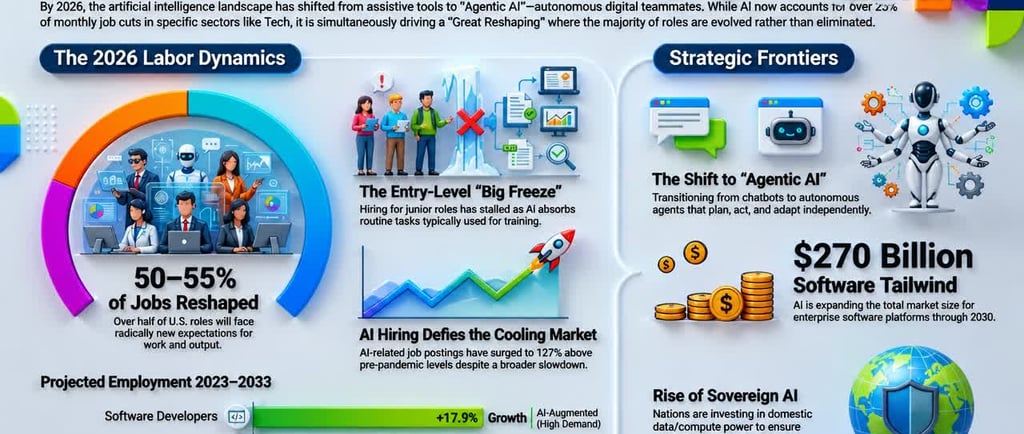
This massive shift is driven by the evolution from basic assistive tools to "Agentic AI." When looking at AI workflow automation vs traditional automation, the differences are stark. Traditional automation was rigid and rule-based; Agentic AI systems can plan, act, and adapt independently, operating as autonomous digital teammates that handle complex, multi-step workflows.
This has led to the rise of an "inverted gig economy". In the near future, the most automated organizations on earth will consist of a handful of human "Agentic Architects" directing fleets of AI agents. These agents will execute 80% to 95% of operational work—coding, planning, researching—and will autonomously post gigs to marketplaces to hire human workers for the remaining 5% of edge cases, such as physical tasks or subjective verifications. We are entering an era where humans will literally be hired by, and report to, AI agents.
Will AI Replace You? Substitution vs. Augmentation
Over the next two to three years, an estimated 50% to 55% of jobs in the US will be fundamentally reshaped by AI, while 10% to 15% of jobs face total elimination. However, task automation does not automatically equal job loss. The impact of AI depends heavily on whether the technology acts as a substitute or an augmenter.
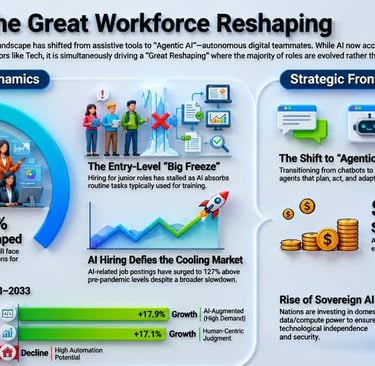
Take software engineering, for example. AI can dramatically accelerate code generation, but it currently lacks the system-level judgment and architectural reasoning required to own complex outcomes end-to-end. Because the demand for digital products is nearly infinite, AI acts as an expander—software engineering is an "Amplified" role where productivity gains lead to more output rather than fewer jobs. In fact, employment projections indicate a 17.9% growth for software developers over the next decade.
Conversely, look at roles characterized by highly structured, repeatable interactions. If you are wondering, can AI automate customer support emails? The answer is a resounding yes. AI agents are now highly capable of resolving routine inquiries, performing account lookups, and generating policy explanations. Because the total volume of customer service interactions is generally bounded by the size of a company's customer base, productivity gains in this sector translate directly into fewer required human representatives. Major corporations like Salesforce and IBM have already executed surgical headcount reductions in customer service and HR departments after AI agents successfully absorbed up to half of all routine interactions.
The "Big Freeze": Why Entry-Level Jobs are Disappearing
Despite dire predictions, the overall unemployment rate in the U.S. has remained near historic lows. If AI is disrupting the workforce, why aren't we seeing mass, headline-grabbing layoffs everywhere?
The answer lies in the "Big Freeze". Companies are not firing masses of existing employees; instead, they are simply getting more output from their current workforce and closing the door to new hires. When a company experiences a 13% voluntary turnover rate, they can achieve their AI-driven downsizing goals simply by not replacing the people who leave.
This silent job destruction is disproportionately hitting recent graduates and entry-level workers before their careers even begin. Early generative AI tools excel at the exact tasks traditionally handed to junior employees: heavy document analysis, scheduling, quoting, first-draft production, and routine code debugging. Unemployment among recent graduates has climbed to nearly 6%, rising twice as fast as the rest of the workforce since 2022. Furthermore, job postings mentioning AI have surged by 127% above pre-pandemic levels, even as the broader labor market cools, indicating that employers are increasingly expecting AI fluency across all knowledge-work roles.
AI as a Corporate Scapegoat
While AI is genuinely restructuring workflows, it is also being used as a convenient excuse for broader corporate failings. In Australia, tech giants like Atlassian, Block (owner of Afterpay), and WiseTech recently cut thousands of jobs, publicly linking the redundancies to the end of manual coding and the era of AI efficiency.
However, analysts warn of "AI-washing". Economic modeling by Gartner suggests that only 1% of recent global job cuts were actually the direct result of AI productivity gains. Many companies citing AI disruption were simultaneously suffering from plummeting share prices, over-hiring during the pandemic, and intense investor pressure.
The legal system is beginning to push back against this narrative. In China, a court in Hangzhou recently set a precedent by ruling that a fintech company illegally terminated an employee after claiming his role could be done cheaper by AI. The court determined that replacing a worker to cut costs via AI did not legally constitute a "material change in objective circumstances" that would justify breaking a labor contract.
The Regulatory Landscape: Banning Workplace Surveillance
As companies rush to implement AI, they are colliding with strict new regulations designed to protect workers. The European Union has taken a decisive global lead with its comprehensive AI Act.
By 2026, the EU AI Act will strictly regulate high-risk AI usage in the workplace, completely banning the use of AI-driven emotion recognition systems. Employers will be legally prohibited from using webcams or voice recognition to monitor an employee's emotional tone during hybrid video meetings, tracking the dissatisfaction of retail workers via in-store cameras, or evaluating a candidate's emotional responses during recruitment. Violations of these rules will result in catastrophic fines ranging from 1.5% to 7% of a company's global revenue.
Labor experts argue that Europe currently does not need additional, fragmented regulatory interventions regarding AI in the workplace, as the AI Act, combined with existing GDPR protections (which give data subjects the right to oppose automated decision-making), already provides a robust framework to protect employees from undue surveillance and discrimination.
The Software Industry's Trillion-Dollar Disruption
The anxiety surrounding AI isn't limited to the labor market; it has deeply rattled the financial foundations of the software industry itself. Recently, the software sector experienced a historic ~$2 Trillion market-cap sell-off as investors panicked that Generative AI would destroy traditional Software-as-a-Service (SaaS) business models.
Investors feared a "DIY risk"—the idea that AI would make coding so cheap that enterprises would stop outsourcing to third-party software platforms and simply build their own internal applications. Furthermore, investors worried that as AI agents shrink enterprise headcounts, legacy software companies that rely on "per-seat" pricing models would see their revenues collapse.
However, financial institutions like Morgan Stanley view this panic as largely overstated. While narrow, lightweight application layers are certainly at risk, mission-critical, heavily regulated enterprise systems of record are highly defensible. AI excels at "probabilistic" tasks (like generating content), but it struggles with high-stakes "deterministic" workflows where compliance, security, and exact outcomes are non-negotiable.
Ultimately, AI is projected to be a massive Total Addressable Market (TAM) expander, providing an estimated $270 billion net tailwind to the software industry over the next five years. To survive, legacy software vendors are rapidly pivoting away from purely seat-based pricing toward hybrid, value-based models that monetize usage, features, and AI-driven outcomes.
What Workers Actually Want: The Human Agency Scale
As the technology races forward, researchers are trying to bridge the gap between AI development and the desires of the actual workforce. The Stanford SALT Lab recently developed the WORKBank database, auditing 1,500 U.S. workers across 104 occupations to map what workers want AI to do versus what it is currently capable of.
The findings reveal a critical mismatch in current tech investments. A staggering 41% of Y Combinator companies are currently building AI solutions in the "Low Priority" or "Red Light" zones—meaning they are automating tasks that workers do not want automated, leading to potential workplace friction.
Stanford introduced the "Human Agency Scale" (HAS) to measure the desired level of human-AI collaboration. The data shows that for 47 out of 104 occupations, workers desire an "Equal Partnership" (Level 3) with AI. When workers do desire automation, it is primarily motivated by a desire to eliminate repetitive stress and free up time for high-value, strategic work. Interestingly, as AI agents enter the workforce, the core competencies valued in humans are shifting away from pure information-processing toward complex interpersonal, organizational, and decision-making skills.
Becoming an Agentic Architect
The window to secure your place in the future economy is measured in months, not years. Within 12 months, the compounding effect of AI-augmented productivity will make the gap between early movers and late adopters almost impossible to cross by sheer effort alone.
To thrive, you must transition from being a passive employee to an "Agentic Architect". This requires three traits:
High Agency: You do not wait for permission or job descriptions. You build and own systems.
Relentless Curiosity: You treat every new AI model as a building block and experiment constantly.
AI Fluency: You do not just write prompts; you orchestrate complex workflows where AI handles the volume and humans handle the exceptions.
Understanding how to use Zapier with AI agents is an excellent practical starting point for building this fluency. By connecting powerful LLMs directly to your everyday applications (like email, CRM, and project management tools), you can construct hands-free, automated systems that execute multi-step business processes while you sleep. You no longer scale by hiring human headcount; you scale by deploying agents.
Conclusion: Reclaiming True Meaning
The rise of AI forces us to confront an uncomfortable truth: the corporate meaning machine was always a trap. We spent decades outsourcing our identity to employers, finding our self-worth in job titles that were deeply tied to meaningless, repetitive abstraction.
AI is breaking that lock. While the transition will be undeniably brutal for millions who are caught unprepared, the ultimate end state is one of liberation. When work is no longer your sole source of identity, purpose becomes easier to find in family, community, craft, and authentic creation.
The agents are coming. The only question is whether you will be the one directing them, or the gig worker they hire to fill in their gaps.
Take control of your transition today. Let The Professional's Roadmap to Digital Freedom by Buzz Leaps be your guide to building compounding advantages before the window closes. The roadmap is waiting.