<script async src="https://pagead2.googlesyndication.com/pagead/js/adsbygoogle.js?client=ca-pub-7001450216977829"
crossorigin="anonymous"></script>
AI Automation for Small Business Owners: Surviving the 2026 Job Market Shift
Traditional jobs face massive disruption in 2026. Discover why mastering AI automation for small business owners is your ultimate escape hatch to career independence and financial freedom.
AI AUTOMATION FOR SMALL BUSINESS OWNERS,GLOBAL EMPLOYMENT TRENDS 2026, AI JOB IMPACT, TECH LAYOFFS 2026, FUTURE OF WORK, JOB MARKET TRENDS WORLDWIDE, AI REPLACING JOBS, HIRING SLOWDOWN 2026, EMPLOYMENT CRISIS GLOBAL, WORKFORCE TRANSFORMATION, JOBS AND AIAI TOOLS, AI AGENTS, AI AUTOMOTION, AI TRENDS
5/21/202614 min read
The Great Reorientation: Why Traditional Jobs Are No Longer Safe and How AI is Rewriting the Future of Work
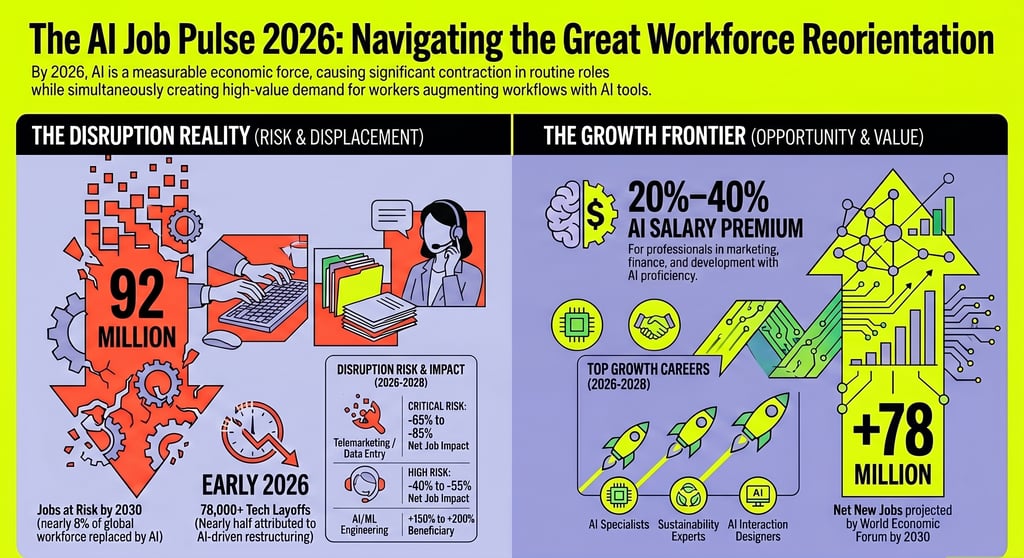
Right now, a silent and invisible phenomenon is sweeping the globe. As of this very moment in 2026, there is a horrifying statistic that most people don’t know: over 330,000 white-collar jobs have been slashed in just the last few months, and experts project a staggering 92 million human jobs will be entirely displaced worldwide by 2030. But here is the bone-chilling suspense—the massive corporations orchestrating these cuts aren’t actually losing work, and the entity replacing these workers doesn’t sleep, doesn’t strike, and operates at a cost that drops by 70% every single year. Yet, a hidden trapdoor exists within this data, a secret paradox that is simultaneously preparing to birth 170 million new roles. What is the true identity of this unstoppable force, and why does this terrifying reality hold the key to your ultimate financial freedom? I will reveal the profound answer to this suspense at the end of our journey today.
Hello, I am Buzz Leaps. As an author and publisher of motivational books, I have dedicated my life's work to a singular mission: encouraging people to take up high-value skills that can help them become truly independent. I am here to tell you that relying on traditional jobs is no longer safe. Your livelihood can be upended overnight by artificial intelligence, geopolitical wars, unpredictable government decisions, shifting company policies, and the volatile current situations we are all experiencing.
The era of the "safe corporate job" is over. We have entered the age of the independent creator, the agile entrepreneur, and the sovereign individual. And the greatest equalizer we have ever seen to help you break free from this fragile system is AI automation for small business owners.
In this comprehensive report, we are going to travel across the globe—from the courtrooms of China to the financial hubs of London, from the tech ecosystems of Canada and the United States to the outsourcing capitals of India and the corporate offices of Australia. We will break down exactly how AI is disrupting the global workforce, which roles are dying, which are thriving, and how you can leverage AI automation for small business owners to reclaim your independence.
The Global Macro-Economic Shift: The Rise of Agentic AI
To understand the job market in 2026, you must understand the underlying microeconomics of computing. We are no longer just dealing with simple chatbots; we have entered the era of Agentic AI—autonomous systems capable of perceiving, reasoning, planning, and executing complex, multi-step workflows.
The math behind this revolution is staggering. The unit cost of computing tokens utilized for AI model inference is currently declining at an annual rate of 60% to 70% due to rapid advancements in semiconductor efficiency. Because the cost of "artificial thought" is plummeting, demand is exploding. Global token consumption is projected to multiply 24-fold between 2026 and 2030, skyrocketing to an incomprehensible 120 quadrillion tokens processed per month.
This exponential demand is fundamentally undermining the traditional corporate software model. The classic "per-seat" SaaS business model is collapsing because a single AI agent can now execute workflows that previously required dozens of human licenses. In response, major tech firms are executing deep headcount reductions to free up capital to fund massive AI infrastructure investments. Meta cut roughly 8,000 roles to redirect savings toward a $145 billion AI infrastructure buildout, while Oracle eliminated between 20,000 and 30,000 roles to replace operational overhead with automated systems.
The United States: A Landscape of Reshaping and Scrutiny
In the United States, research indicates that the direct elimination of entire occupations will occur gradually, but the immediate impact is concentrated in the radical reshaping of existing roles. According to OpenAI, approximately one in five (20%) US jobs faces a high risk of AI automation, defined as having more than 50% of their daily tasks exposed to the technology.
However, labor economists at BCG project that 50% to 55% of all US jobs will be reshaped over the next two to three years, while complete technological substitution is projected to eliminate 10% to 15% of US jobs over a five-year horizon.
This rapid transformation has forced municipal governments to prepare for potential economic shockwaves. Released today, May 21, 2026, the New York City Comptroller published a major report modeling AI's fiscal impact. The report outlines five distinct scenarios for the city's future, including a 35% probability of an "AI-Empowered Economy" with productivity gains, but crucially, a 5% probability of an "AI Shockwave" scenario. In this shockwave scenario, the labor market fails to absorb displaced workers smoothly, leading to the concentrated loss of over 145,000 white-collar jobs in office-using industries by 2030, severely damaging the city's tax base.
Simultaneously, the deployment of AI in human resources is facing unprecedented legal scrutiny. The landmark class-action lawsuit Mobley v. Workday continues to escalate in federal court, challenging algorithmic screening tools for systemic bias. In response, on May 1, 2026, Connecticut passed the Artificial Intelligence Responsibility and Transparency Act (SB 5), making it explicit that relying on an automated tool is not a legal defense to discrimination claims, and forcing corporate HR departments to provide plain-language disclosures when using AI for hiring.
Canada: High Adoption, Youth Anxiety, and the Talent Bottleneck
Canada is experiencing a unique manifestation of the Agentic AI transition. According to a 2026 survey by KPMG, a staggering 77% of Canadian organizations are already deploying agentic AI systems, and 66% are actively moving toward a fully integrated human-AI workforce.
Yet, this rapid adoption has triggered profound anxiety, particularly among the youth. The 2026 Canadian Employment Pulse Check by Borderless AI reveals that 57% of Canadians aged 18–24 say AI is negatively impacting their long-term career opportunities. Among these young workers, 49% feel less secure and are actively reconsidering their career paths. Interestingly, university-educated Canadians are nearly twice as likely to feel the impact of AI on their careers compared to those with only a high school diploma, proving that traditional white-collar credentials are no longer a shield against disruption.
Despite the fear of AI replacement, the dominant concern for Canadian workers remains wage stagnation (41%), fueled by a high cost of living and a tightening labor market.
The irony of Canada's rapid AI deployment is that it has created a massive talent bottleneck. While 70% of organizations say AI is delivering value, only 3% have achieved measurable financial returns. Why? Because they lack the human talent required to manage these systems. There is an acute global shortage of "AI Agent Architects," with demand outstripping supply by a ratio of 8 to 1. Biopharmaceutical leaders like Sanofi are currently scrambling to hire Toronto-based AI-ML Leads for Agentic AI Systems, offering salaries up to $180,966 CAD just to find professionals who can orchestrate these autonomous agents.
Europe and the United Kingdom: The White-Collar Retrenchment
Across the Atlantic, the integration of agentic AI is accelerating a ruthless consolidation of back-office operations. The UK is currently losing more jobs to AI than it is creating, suffering harder hits than rival large economies. British companies recently reported an 8% drop in net jobs over the past 12 months due to AI.
This white-collar retrenchment is heavily concentrated in the financial sector. Standard Chartered has announced it will cut approximately 7,800 back-office roles by 2030—representing more than 15% of its support functions globally. The bank’s chief executive explicitly targeted human resources, risk, and compliance professionals, stating the goal is to replace "lower-value human capital" with technology to boost income per employee by 20%.
Analysts at Morgan Stanley estimate that up to 200,000 jobs could disappear from European banking alone by 2030. The tasks most vulnerable are the highly structured, rules-based tasks in the middle and bottom of the corporate hierarchy: document processing, data aggregation, and administrative coordination.
This corporate strategy is creating a massive barrier for young workers. In the UK, job vacancies in roles viewed as vulnerable to AI have collapsed by 37% since the launch of ChatGPT, contributing to a youth unemployment rate that has climbed to 13.7%.
Australia: The Adoption Divide and the "AI-Washing" Illusion
Bucking the global panic narrative, a landmark study of 4,000 Australian firms by the national science agency, CSIRO, revealed a fascinating trend: companies that adopt AI are not shedding workers. In fact, AI-adopting companies posted 36% more non-AI job advertisements over time than their non-adopting peers. The study found that demand for AI-exposed roles only declined in firms that failed to adopt the technology, proving that workers are most disadvantaged when their employers refuse to evolve.
To help the workforce adapt, the Australian government launched the country's first interactive "AI Jobs Map" (Future Work AU). As discussed on Channel 7's The Morning Show, this tool reveals the "Red Zone" of highly exposed careers—such as general clerks, accountants, and software programmers—and provides pathways for workers to upskill and augment their roles before they are displaced.
However, the Australian market is also battling corporate deception. Many professionals suspect that "AI-driven restructuring" is being used by executives as a convenient narrative to cover up mass offshoring to lower-cost labor markets—a practice dubbed "AI-washing". The Commonwealth Bank of Australia (CBA) recently faced intense union backlash after attempting to cut 45 customer support roles by introducing a voice bot. The system failed to manage call volumes, forcing CBA to reverse the cuts and proving that rushing to replace human empathy with unproven automation is a dangerous corporate gamble.
China: World-First Worker Protections and Sovereign AI
In a stark contrast to the Western world's "at-will" employment models, Chinese courts have drawn a definitive line in the sand. In a world first, courts in Hangzhou and Beijing have ruled that companies cannot legally fire employees simply because artificial intelligence can now do their jobs cheaper.
In Hangzhou, a quality assurance supervisor named Zhou was fired after his company automated his role using large language models and he refused a 40% pay cut. In Beijing, a data collector named Liu was terminated after 17 years when his company shifted to AI-driven map data collection. In both cases, the courts ruled the dismissals unlawful. The judicial reasoning established that adopting AI is a "strategic business choice" made by the employer, not an unforeseeable change in objective circumstances that justifies termination under China’s Labour Contract Law.
The courts asserted a powerful mandate: companies are prohibited from shifting the operating costs of technological transformation onto their employees. If an employer automates a role, they must prioritize retraining, skills upgrading, or internal transfers rather than resorting to direct termination.
Simultaneously, China is aggressively pushing forward with sovereign AI capabilities. On May 8, 2026, the Chinese government issued national guidelines to regulate and promote the development of AI agents across 19 key economic and social sectors. The state's goal is to control the expansion of technology to ensure efficiency gains do not trigger mass unemployment and social instability, particularly given an urban youth unemployment rate of 15.3%.
India: The Shrinking Back Office and the Pivot to High-Value Innovation
For a quarter-century, India has served as the world's back office, leveraging a massive English-speaking workforce to deliver cost-effective IT and business process outsourcing (BPO). This $300 billion industry, which employs over six million people, is now facing an existential threat.
At the recent India AI Summit, venture capitalist Vinod Khosla issued a stark warning: traditional IT services and BPO roles will "almost completely disappear" within five years. Because AI replicates cognitive labor itself, the traditional model of "wage arbitrage"—offshoring tasks to humans in lower-cost regions—is being rendered economically obsolete by digital tokens that operate at a fraction of a human's cost.
We are already seeing this on the ground. Startups like Hunar.ai in Gurugram are deploying bespoke conversational AI voice agents that handle entire hiring processes—from resume screening to orientation—eliminating the need for human HR coordinators. This transition is destroying the traditional "fresher" hiring pipelines for young engineers in Tier-2 and Tier-3 cities, who previously relied on manual coding and testing jobs to enter the middle class.
However, India is executing a massive strategic pivot. Global enterprises are rapidly establishing Global Capability Centres (GCCs) in India, transforming the region from a low-level service provider into a high-value hub for Agentic AI research and development. GCCs have boosted their share of India's IT hiring market to 27% in 2025, driving a 16% jump in demand for IT professionals to 1.8 million roles. The paradigm has shifted: the demand is no longer for generalist coders, but for highly skilled AI problem solvers and domain specialists.
The Anatomy of Job Disruption: What is Dying and What is Thriving?
To survive this reorientation, you must understand exactly how the labor market is segmenting. We are seeing an extreme bifurcation between commoditized operational tasks and high-value strategic oversight.
Roles Facing Critical Elimination (2026-2028):
Data Entry & Processing Clerks: Facing a 65% to 80% reduction. AI-powered intelligent document processing has made manual entry obsolete.
Telemarketers & Tier 1 Customer Service: Facing a 55% to 85% reduction. Multilingual conversational agents are handling high-volume outreach and basic queries instantly.
Basic Bookkeeping & Accounting: Facing a 35% to 50% reduction. Automated ledgers and reconciliation tools are replacing manual number-crunching.
Commodity Content Writers: Facing a 40% to 60% reduction. Content mills producing basic SEO articles have been obliterated by generative models.
Roles Experiencing Explosive Growth:
AI/ML Engineers & Agent Architects: Experiencing 150% to 200% growth. Demand is extreme, with salaries soaring between $130,000 and $300,000+ as companies desperately seek talent to build and govern multi-agent systems.
Data Analysts & Scientists: As AI generates more data, human analysts are required to interpret insights and drive strategic business decisions.
Cybersecurity Specialists: With the expansion of AI comes an expansion of digital threats, driving massive demand for automated threat defense experts.
MIT labor economist David Autor's landmark research perfectly frames this transition. Autor notes that technological change automates existing tasks, but it simultaneously reinstates labor by creating entirely new domains of human expertise. Historically, this "new work" requires mastering a new capability. As Autor states, "What makes labor valuable is not simply the ability to do stuff, but specialized knowledge. And it has to be scarce. If everyone is an expert, then no one is an expert".
This means that your goal is not to compete with the machine on execution; your goal is to become the expert who orchestrates the machine.
Your Escape Hatch: AI Automation for Small Business Owners
This brings us to the core of my philosophy, and the ultimate solution to the fragility of the modern job market. You can no longer rely on a corporation to guarantee your financial safety. Executives are actively incentivized to replace you to fund their data center buildouts. Governments are struggling to keep up with the pace of regulation.
But there is a silver lining that represents the greatest wealth-creation opportunity in modern history. The exact same deflationary computing costs that are destroying corporate middle-management jobs are placing enterprise-grade infrastructure directly into your hands.
AI automation for small business owners is the ultimate equalizer. An incredible 93% of business leaders agree that affordable cloud-based and AI-enabled tools allow smaller firms to reach absolute parity with digital leaders.
You no longer need a massive team of accountants, marketers, and customer service reps to launch and scale a highly profitable venture. By embracing AI automation for small business owners, you can build an agile, hyper-efficient micro-business. You can use AI bookkeepers like Vic.ai to manage your finances, deploy bespoke conversational agents to handle your customer inquiries 24/7, and utilize AI content strategists to dominate your marketing channels.
The strategy is simple:
Attain AI Literacy: Understand what Large Language Models can and cannot do.
Achieve Tool Proficiency: Master the specific automation tools relevant to your niche (e.g., Zapier, Make, custom GPTs).
Become "AI-Augmented": The data is undeniable. Professionals who are "AI-Augmented" command a 20% to 40% salary premium over their peers. An AI-Augmented Marketer or Financial Analyst produces the output of three people.
Launch Your Independence: Use these augmented skills not to beg for a corporate job, but to offer high-value services directly to clients as an independent consultant or small business owner.
The Big Reveal: The Paradox of the 92 Million
We have reached the end of our journey, and it is time to reveal the answer to the horrifying suspense I introduced at the beginning of this report.
I told you that 330,000 jobs have been cut, that a single technological shift will consume 120 quadrillion units of 'thought' by 2030, and that 92 million jobs will be displaced globally. I asked you to identify this unstoppable force that never sleeps and is dropping in cost by 70% a year.
You might think the answer is simply "Agentic Artificial Intelligence." You might think the machines have won.
But here is the secret paradox that explains why 170 million new roles are being created simultaneously: AI is not replacing humans. Humans using AI are replacing humans who don't.
The entity consuming those 120 quadrillion tokens is not a rogue machine acting on its own; it is the AI-Augmented Entrepreneur. It is the human being who realized that relying on a corporate paycheck is a trap, and instead decided to wield this incredible technology to multiply their own output.
The true nature of this disruption is what experts call a "capability overhang"—a vast delta between what AI models are already capable of doing and what rigid, slow-moving corporations have successfully adopted. Large companies are failing to implement AI effectively because of data fragmentation, internal silos, and cultural resistance.
This is your profound opportunity. While giant corporations stumble over integration complexities and lay off workers to fund their tech debt, you have the agility to move instantly. The 92 million jobs being eliminated are the old, robotic, repetitive tasks that humans were never meant to do in the first place. The 170 million new jobs belong to the architects, the strategists, the creators, and the small business owners who use AI to build the future.
The system is no longer safe. The corporate ladder is broken. But by mastering AI automation for small business owners, you don't just survive the great reorientation—you conquer it. Take control of your skills, embrace the technology, and declare your independence today.
--------------------------------------------------------------------------------
References:
"60+ Shocking AI Job Replacing Statistics Relevant for 2026", Tenet.
"AI Will Reshape More Jobs Than It Replaces", BCG.
"AI Agents Forecast to Boost Tech Cash Flow as Usage Soars", Goldman Sachs.
Goldman Sachs Research on Token Consumption. Goldman Sachs Research on Inference Cost Decline.
"AI Hiring Tools Under Scrutiny", CBIA (Mobley v. Workday).
"AI Hiring Tools Under Scrutiny", CBIA (Connecticut SB 5).
"AI Hiring Tools Under Scrutiny", CBIA.
"AI Summit 2026: Vinod Khosla warns of job market shake-up", Mint.
"AI Summit 2026: Vinod Khosla", Mint.
"AI Will Reshape More Jobs Than It Replaces", BCG.
"AI adopters aren't cutting jobs, they're creating them", CSIRO.
"AI adopters aren't cutting jobs", CSIRO. "AI adopters aren't cutting jobs", CSIRO.
"AI adopters aren't cutting jobs", CSIRO.
"AI and New York City's Fiscal Future", Office of the New York City Comptroller.
"AI and New York City's Fiscal Future", NYC Comptroller.
"AI and New York City's Fiscal Future", NYC Comptroller.
"AI cuts routine IT jobs as GCCs drive 2026 hiring in India", Outsource Accelerator.
"AI cuts routine IT jobs", Outsource Accelerator.
"AI is hitting UK harder than other big economies, study finds", The Guardian.
"AI-ML Lead - Agentic AI Systems at Sanofi".
"Assessment Agents - AI HRs for frontline workforce management", Hunar.ai. "
Australia's first AI jobs map reveals career risks", The Morning Show. "
Australia's first AI jobs map", The Morning Show. "Australia's first AI jobs map", The Morning Show.
"Canadian business leaders expect agentic AI to reshape the workforce", KPMG.
"Canadian business leaders expect agentic AI", KPMG.
"China issues guidelines to regulate, promote AI agents", China Daily.
"China issues guidelines", China Daily.
"China's Courts Rule It's Illegal to Fire Workers and Replace Them with AI", BigGo Finance. "
China's Courts Rule It's Illegal to Fire Workers", BigGo Finance.
"Chinese Courts Say Companies Can't Fire Workers Just Because AI Can Do the Job Cheaper", r/AIGuild.
"Emerging IT Talent Trends Canada 2026", ClarityArc Consulting.
"India Built the World's Back Office. A.I. Is Starting to Shrink It", Reddit / NYT.
"India Built the World's Back Office", Reddit. "
"Major international lender targets 'lower-value human capital' in cutting 8,000 jobs", HRD.
"Major international lender targets", HRD.
"One in five US jobs faces high risk of AI automation, OpenAI finds", Crypto Briefing.
"PwC's 2026 Digital Trends in Operations", PwC.
"Technology usually creates jobs for young, skilled workers. Will AI do the same?", MIT News.
"The 2026 AI Job Disruption Report", AI Magicx. .
"The 2026 Canadian AI & Employment Report", Borderless AI.
"The Great Reorientation", Macroeconomic Implementation Gap.
"The Great Reorientation", Token Demand.
"The Great Reorientation", Capability Overhang.
"The Great Reorientation", Corporate Restructuring.
"The Great Reorientation", US Labor Market.
"The Great Reorientation", Judicial Risks.
"The Great Reorientation", Legislative Action.
"The Great Reorientation", NYC Scenarios.
"The Great Reorientation", Canadian Metrics.
"The Great Reorientation", Canadian Talent.
"The Great Reorientation", UK Retrenchment.
"The Great Reorientation", UK Youth Unemployment.
"The Great Reorientation", Australian Firms.
"The Great Reorientation", Australian Offshoring.
"The Great Reorientation", Chinese Jurisprudence.
"The Great Reorientation", Chinese Guidelines.
"The Great Reorientation", Indian Pivot.
"The Great Reorientation", GCC Hiring Shift.
"The Great Reorientation", GCC Innovation.
"The Great Reorientation", Career Restructuring.
"The Great Reorientation", Global Disruption Matrix.
"The Great Reorientation", David Autor's Research.
"Unemployed? 330,000 jobs cut since Jan 2026", r/Layoffs.